

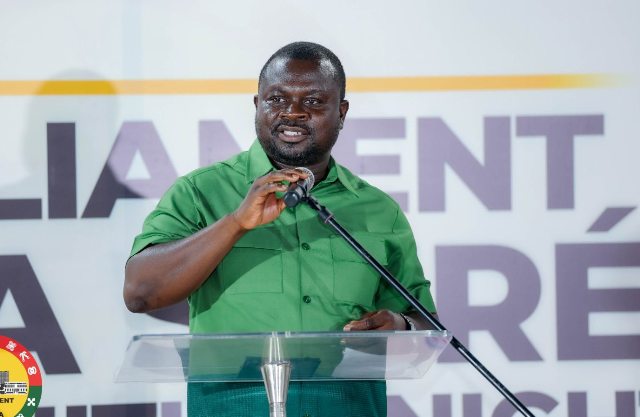

The President of the Ghana Journalists Association (GJA), Albert Kwabena Dwumfour, has commended Parliament for acknowledging the media’s essential role in Ghana’s democratic framework.
He urged the legislative branch to enhance protections for journalists and cultivate a supportive work environment.
He stated that the media-parliament relationship is crucial for ensuring and improving democracy, emphasizing that without media coverage, citizens would be unaware of how their Members of Parliament represent them or how laws are enacted.
Also read: CRC proposes leaner executive; Recommends maximum of 57 ministers
Addressing Parliament’s Media Soiree and Recognition Night last Friday, Dwumfour reiterated the Parliamentary Press Corps’ (PPC) essential role in promoting transparency and democratic accountability.
He also lauded the Speaker of Parliament, Rt. Hon. Alban S.K. Bagbin, for cultivating a harmonious and collaborative relationship between Parliament and the media.
“Under your stewardship, there has not been any conflict or tension between Parliament and journalists, and I want to commend you for that,” he said.
Press freedom
The GJA President, however, appealed for sustained institutional support, improved working conditions, and an enabling environment for journalists covering parliamentary proceedings.
“We call for continuous institutional support and an enabling environment that strengthens democratic participation and public trust,” he stressed.
Mr. Dwumfour reminded journalists of their responsibility to uphold ethical standards, accuracy, and fairness in parliamentary reporting.
He argued that as the media preaches press freedom, it must also ensure media responsibility and warned that journalism must inform and not divide the nation.
He cautioned against sensationalism and partisan bias, urging reporters to prioritise facts and national interest.
Dwumfour raised concerns over the use of certain sections of the Electronic Communications Act against journalists, insisting the law was never intended to silence the media.
“The Electronic Communications Act is being used to stifle press freedom… We call on Parliament to review or amend it to ensure it is not used against journalists,” he called out.
He urged Parliament to resist any legislation that could gag free speech and to reform defamation-related laws that criminalise journalistic work.
“We remind Parliament of its constitutional duty to protect freedom of expression and resist laws that stifle free speech,” he added.
Addressing economic pressures affecting Ghana’s press freedom ranking globally, Dwumfour appealed for standardised remuneration and improved welfare structures for journalists.
He appealed to Parliament to support a Private Members’ Bill to secure structured conditions of service for journalists nationwide.
Dwumfour reaffirmed the GJA’s commitment to defending press freedom, promoting professionalism, and strengthening democratic governance, stating, “The media is the oxygen of democracy and must be strengthened, not strangled.”