

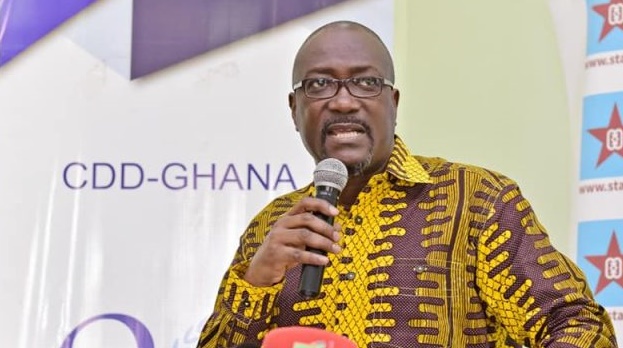

Professor Henry Kwasi Prempeh, Chairman of the Constitution Review Committee, has stated that implementing a five-year presidential term may disrupt Ghana’s existing trend of automatic eight-year presidencies.
In a discussion on Joy News on December 25, he noted that the current four-year term provides presidents with limited time to govern effectively.
He explained that the process of appointing officials, including the new Council of State, can be drawn out, which subsequently affects governance in the initial stages of a presidency. He mentioned efforts to address these delays to improve management during early governance.
Also read: IMF seeks 3-month extension of Ghana’s Programme
Beyond administrative delays, Prof Prempeh said the committee examined global trends and found Ghana is now out of step.
“Ghana is among a dwindling number of countries that still do four years, especially new democracies and in Africa,” he said.
He noted that longer terms are now the norm. “Most do five. In our region, some do seven,” he said.
“Benin and Liberia, I think, do six years. Nigeria and Ghana have four years. We and Nigeria are always matching together lockstep.”
According to him, the evidence was clear. “The global norm now has shifted from four to five in presidential systems,” he said, adding that “in our own region, five is the norm.”
Prof Prempeh said the committee accepted that term limits are not fixed by science.
“Since any number is arbitrary, then let’s be guided by comparative best practice,” he said. “So if the world is moving towards five, then maybe it makes sense five.”
He said voter behaviour was also central to the proposal. “People tell us, ‘Oh, when their term is coming to an end, give us another term. We didn’t have enough time,” he said.
According to him, voters often accept that argument under the four-year system. “A Ghanaian voter might accept that four years is not enough and give you a second term to finish your work,” he said.
But he said a five-year term changes the calculation. “If you have five years, it is going to be difficult to convince a voter that five years was not enough,” he said.
Prof Prempeh stressed that the proposal is tougher on incumbents, not easier. “Our thinking is that actually five years is tough on the incumbent,” he said.
He said poor performance would carry consequences. “If you have not performed well in five years, Ghanaians are not really going to entertain the thought of letting you stay,” he said.
According to him, this could disrupt Ghana’s eight-year pattern. “The four, four was becoming like a tradition, like everybody gets eight,” he said.
But he said a five-year system may change outcomes. “This time, we may be getting more presidents getting five,” he said.
Prof Prempeh rejected the idea that the proposal guarantees a longer rule. “It’s not like you just multiply five by two and say, hey, 10 years, there is too much,” he said.
He said earning a second term would be harder. “The 10 is going to be difficult to get,” he added.
Myjoyonline