

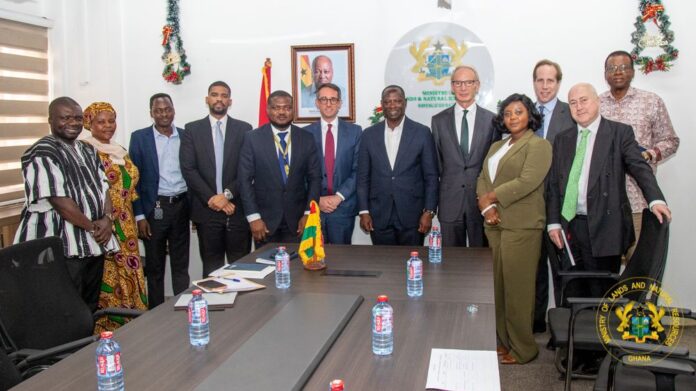

The Government of Ghana has sealed a strategic partnership with the World Gold Council (WGC) to tackle illegal mining and reform the artisanal and small-scale mining (ASM) sector through the introduction of a fully traceable gold supply chain.
The collaboration, led by the Ministry of Lands and Natural Resources, will be rolled out under the Responsible Cooperative Mining and Skills Development Programme (rCOMSDEP).
The programme seeks to establish regulated, community-based gold processing centres aimed at formalising gold production, strengthening supervision, and eliminating illicit trade within the sector.
Also read: Ivory Coast set up Egypt clash after dominant 3-0 win over Burkina Faso
The partnership was deliberated at a high-level meeting between officials of the Ministry and the World Gold Council on Monday, January 5, 2026. Addressing the engagement, the Minister for Lands and Natural Resources, Hon. Emmanuel Armah-Kofi Buah, MP, said the initiative forms part of the government’s wider agenda to formalise ASM activities, promote responsible mining practices, add value to Ghana’s mineral resources, and decisively confront illegal mining, popularly known as galamsey.
According to the Minister, the initiative builds on outcomes from the 2025 Mining in Motion Summit and is designed to redirect gold production into transparent, regulated channels, thereby dismantling informal and illegal supply chains that have persistently weakened the sector.
Chief Executive Officer of the World Gold Council, David Tait, described Ghana’s rCOMSDEP initiative as a credible and scalable model for ASM formalisation worldwide. He said the framework responds to rising global demand for responsibly sourced gold by ensuring traceability, standardisation and adherence to international market standards. He added that the programme is also expected to draw responsible investment into Ghana’s ASM subsector.
Central to the partnership is the creation of an integrated gold value chain anchored on three key pillars: full traceability from mine to market, the establishment of centralised community processing facilities to consolidate and monitor gold output, and the use of official buying and marketing channels.
The two sides agreed on a clear implementation roadmap, including the establishment of a joint technical working team to oversee transparency and accountability throughout the process. Subject to funding confirmation, the first processing plants are expected to be operational within six months.
The Ministry said the partnership represents a major milestone in efforts to transform Ghana’s gold industry by enhancing transparency and sustainability, ensuring equitable benefits for mining communities, and repositioning the ASM sector as a responsible and dependable contributor to national economic growth.