

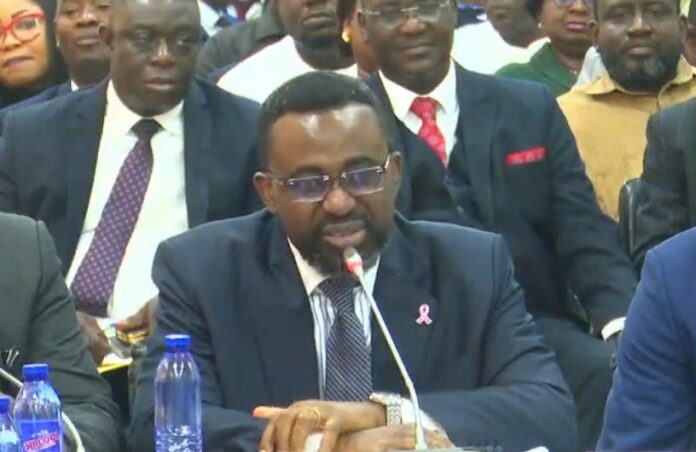

The Governor of the Bank of Ghana (BoG), Dr. Johnson Pandit Asiama, has disclosed that the central bank incurred multi-billion cedi losses under the Gold-for-Oil and Gold-for-Reserves programmes.
Describing the initiatives as quasi-fiscal interventions that must ultimately be absorbed by the government, he said they were introduced in 2021 to address pressing national challenges, including fuel supply stability and foreign reserve accumulation.
Appearing before Parliament’s Public Accounts Committee (PAC) during deliberations on the Report of the Auditor-General on the Consolidated Statements of Foreign Exchange Receipts and Payments of the Bank of Ghana, Dr. Asiama explained that because the programmes are quasi-fiscal in nature, the government must ultimately make provision for their costs.
Also read: Gov’t pays US$393m in IPP legacy debts in 2025 – Finance Ministry
Dr. Asiama confirmed that the Gold-for-Oil (G4O) programme was terminated in May 2025 following mounting losses and operational challenges.
He disclosed that the programme recorded a GH¢74.44 million loss in 2022, GH¢317.69 million in 2023, and GH¢1.8 billion in 2024.
“Since May of last year, we have had to shut that down. An external audit is currently underway, and the entire programme is being audited,” he told the Committee.
He added that despite the cancellation, fuel supply remained stable.
“Since we cancelled the Gold-for-Oil programme, we haven’t seen a buildup of queues at the pumps. So we believe that the cancellation was worth it,” he stated.
The Governor also revealed that the Gold-for-Reserves (G4R) programme recorded even higher losses, including a GH¢1.05 billion loss in 2023 and GH¢3.8 billion in 2024. However, unlike Gold-for-Oil, the programme has not been discontinued.
Dr. Asiama explained that the core objective of G4R—building Ghana’s foreign reserves—remains valid.
According to him, the issue is not whether to shut down the programme, but how to enhance its efficiency and eliminate inefficiencies.
He noted that the BoG Board has authorized a comprehensive external audit covering the programme’s operations from its inception through 2025.
Despite the losses, the Bank of Ghana has recorded a significant improvement in reserve levels.
Dr. Asiama informed the Committee that gross international reserves stood at US$13.829 billion as of December 2025, up from US$8.6 billion in 2024.
However, he cautioned that the central bank is no longer in a position to absorb the costs associated with quasi-fiscal programmes, citing the BoG’s weakened balance sheet since 2022.
“We are not in a position to shoulder those costs going forward,” he said, adding that discussions are ongoing with the Ministry of Finance for reimbursement of losses already borne by the Bank.
He urged Parliament to support efforts to ensure that future costs are explicitly budgeted for by the government.
“If the government decides to budget for those costs, then we free the financials of the Bank of Ghana,” the Governor noted.
Dr. Asiama appealed for unity and reform rather than blame, stressing that the losses are not new and existed before 2025.
He argued that rather than apportion blame, stakeholders should focus on reforming the programmes to improve efficiency and safeguard the national interest.