

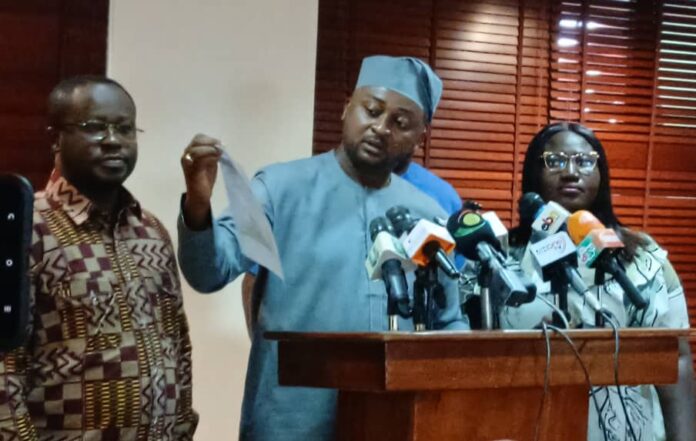

The Minority in Parliament has accused the government of covertly introducing controversial LGBTQ and gender identity concepts into Ghana’s Senior High School (SHS) curriculum, describing the move as a calculated attempt to bypass national consensus and parliamentary scrutiny.
According to the Caucus, the inclusion of LGBTQ-related tendencies through redefined notions of sex, sexuality, sexual orientation, sexual rights, and gender identity in a nationally approved SHS teacher manual amounts to policy by stealth.
At a press conference on Thursday, the Member of Parliament for Old Tafo and Ranking Member on the Education Committee, Vincent Assafuah, argued that the development represents a deliberate effort to smuggle ideologically driven content into state-approved teaching and learning materials.
“What we are witnessing is not an accident or an oversight,” Mr Assafuah stated.
Also read: Morocco knock out Nigeria to reach AFCON final after dramatic penalty shootout
The controversy centres on the Physical Education and Health Elective Teacher Manual developed under the supervision of the National Council for Curriculum and Assessment (NaCCA).
According to the Minority, the definitions contained in the manual promote LGBTQ concepts and depart sharply from Ghana’s cultural, religious, biological, and moral values.
Mr Assafuah argued that curriculum development follows structured institutional processes and therefore cannot be insulated from political responsibility.
“These materials pass through layers of review, approval, and quality assurance. To suggest that no one noticed this content strains credibility,” he said.
The Minority expressed alarm at what it described as the government’s disturbing silence since the issue entered the public domain, insisting that silence on such a sensitive matter amounts to a deliberate policy choice.
“On issues the government considers important, it invokes urgency and acts swiftly. On this defining moral issue, it has chosen evasion,” Mr Assafuah noted.
Drawing a contrast between the National Democratic Congress’ (NDC) posture in opposition and its conduct in power, the Minority recalled repeated statements by leading party figures who argued that failure to pass the Human Sexual Rights and Family Values Bill—popularly known as the anti-LGBTQ bill—amounted to endorsing homosexuality.
“Ghanaians were promised decisive legislative action once political power changed hands. Today, that promise rings hollow,” Mr Assafuah said.
He cited the removal of the reintroduced Human Sexual Rights and Family Values Bill from the Order Paper within 24 hours as clear evidence of a lack of political will.
The Old Tafo MP, also a sponsor of the reintroduced anti-LGBTQ+ Bill in Parliament, referred to Parliament’s record of passing numerous bills under Certificates of Urgency during the current session, arguing that legislative time is made available whenever the Executive deems a matter important.
“Urgency is not accidental. It is directed. The absence of urgency on this issue is therefore intentional,” he stressed.
The Minority issued a series of demands, including the immediate withdrawal of all SHS teaching and learning materials containing gender identity and LGBTQ-related content.
They also called for the dismissal of the Director-General of NaCCA and the Chairperson of the NaCCA Board, as well as the establishment of a full parliamentary inquiry into how the materials were developed, approved, funded, and circulated.
Mr Assafuah urged parents, teacher unions, traditional leaders, and religious bodies to closely examine the content of the teacher manual and speak out.
“Education shapes values. When values are altered without consent, the nation has a duty to respond,” he said.
He challenged the government to clearly state its position to the Ghanaian people, stressing that the issue transcends partisan politics.
According to him, the matter is fundamentally about trust, transparency, and the moral direction of Ghana’s education system, making an official government response imperative.