

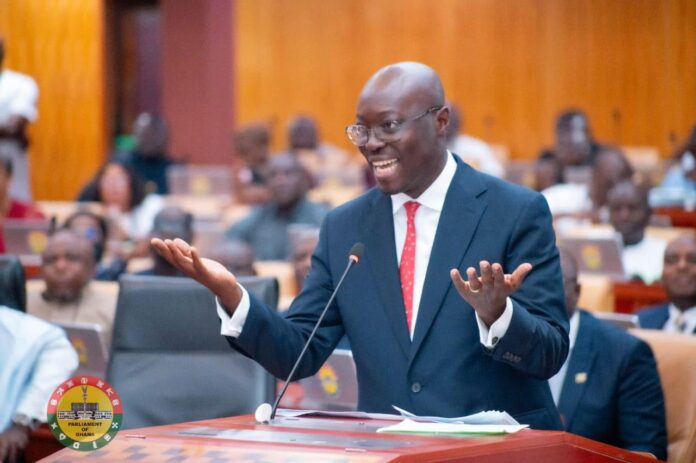

Minister for Finance, Cassiel Ato Forson, has laid before Parliament a Value for Money Office Bill, 2026, aimed at tackling inflated contracts, abandoned projects, and wasteful public spending.
Presenting the Bill in the House, Dr. Forson said the proposed law would institutionalise a national framework to ensure that every cedi spent by government delivers maximum value to citizens.
“This Bill aims to ensure that every Cedi spent by the government delivers the maximum possible benefit in terms of economy, efficiency, effectiveness, equity and sustainability,” he stated.
Also read: Thanksgiving Service held for Clerk to Parliament, Ebenezer Ahumah Djietror
According to the Finance Minister, the legislation is designed to address long-standing challenges in public financial management, particularly those linked to inflated contract prices, persistent cost overruns, abandoned infrastructure projects, and widespread wasteful expenditure, which have over the years, undermined efficiency, strained public resources, and weakened public confidence in government spending.
He noted that poor value-for-money practices have undermined development and public trust over the years. “By institutionalising a value-for-money framework, we will reduce waste and strengthen fiscal discipline,” Dr. Forson said.
A key feature of the bill is the establishment of a Value for Money Office Authority (VFOA), which will operate as an independent oversight body.
Dr. Forson explained that the VFOA will conduct comprehensive value-for-money assessments, issue mandatory certificates before major contracts are awarded, monitor compliance across ministries, departments and agencies, and enforce appropriate sanctions against institutions or officials found to have violated established procedures.
“The establishment of the VFOA will create a specialised and independent institution with the technical mandate to ensure accountability,” he told the House.
The Finance Minister indicated the Bill would transform Ghana’s public financial management system by promoting transparency and uniform pricing across government contracts.
“This bill seeks to institutionalise value-for-money oversight and reduce contract inflation and wasteful expenditure,” he said.
He added that the law would also boost investor confidence and align Ghana with global best practices.
Dr. Forson cited examples from countries that have adopted statutory frameworks on value-for-money oversight, including the United Kingdom, Canada, Singapore, Slovakia, and the United States, noting that these nations have established strong legal and institutional mechanisms to ensure the efficient and accountable use of public funds.
He explained that these countries have established strong audit and accountability systems to ensure optimal use of public funds. Ghana, he said, seeks to follow the same path and ensure that every cedi counts in the award of government contracts.
Following its presentation, the Bill was formally referred to the Committee on Finance for further consideration and reporting. The committee is expected to review the provisions and consult stakeholders before submitting its recommendations to the House.
Dr. Forson stressed that the overarching objective of the Value for Money bill is to strengthen governance and restore public confidence in the management of state resources. If passed, the law is expected to mark a major shift in how government contracts and public projects are evaluated and monitored in Ghana.