

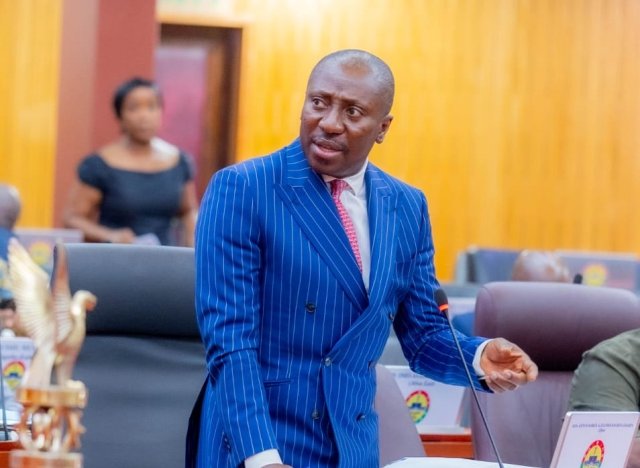

Minority Leader Alexander Kwamena Afenyo-Markin has slammed the government’s new reserve accumulation policy, accusing the Finance Minister of failing to address the everyday economic struggles of ordinary Ghanaians.
According to him, the statement focused too much on technical projections, theories, and long-term targets, while ignoring urgent issues such as unemployment, rising electricity tariffs, and farmers’ welfare.
Reacting to the presentation of the Ghana Accelerated National Reserve Accumulation Policy in Parliament on Wednesday, February 25, Afenyo-Markin said, “The Finance Minister came here with his technical team to present a document full of theories,” he said. “But Ghanaians are not feeling these theories in their pockets.”
Also read: The Front pages: Thursday, 26th February, 2026 (Newspapers)
Economy for numbers
The Minority Leader questioned the relevance of projecting 15 months of import cover when many citizens are struggling to survive.
“With Mr Speaker, we are not managing the economy for statistics. We are managing the economy for the ordinary person on the streets,” Afenyo-Markin stated.
He argued that while government officials celebrate falling inflation figures and theories, market prices remain high.
Indicated that food is expensive, so expensive on the market, and questioned the impact of the falling inflation that the government is touting.
According to him, economic policy must be measured by its impact on households, not by technical reports.
Afenyo-Markin also accused the government of failing to deliver on its job creation promises, particularly to young people.
“I start from the youth,” he said. “You promised jobs. One year into office, how many young people have you employed?”
He challenged the Finance Minister to present concrete data on employment created in the past year rather than focusing on reserve targets.
Rising tariffs
The Minority Leader also criticised what he described as harsh energy policies, accusing the government of worsening living conditions through increased electricity charges.
“The first thing they did was to increase electricity taxes. Bills have gone up by over 100 per cent in some cases,” he said.
He argued that higher utility costs are putting pressure on families and small businesses, making it harder for them to survive.
“These are the realities of our people. You cannot ignore them,” Afenyo-Markin stressed.
Cocoa farmers
Touching on the cocoa sector, the Minority Leader said farmers continue to suffer despite government assurances.
The producer price of cocoa, he said, is not enough, warning that if farmers’ incomes cannot be improved, only for governemnt to fail them.
He also criticised the overall business climate, saying entrepreneurs need stable policies, affordable credit, and reliable infrastructure.
“What businesses need is a proper environment to grow,” he said. “This minister is not offering that.”
According to him, economic growth will only happen when opportunities are created for private sector expansion.
Priorities
Afenyo-Markin accused Finance Minister Cassiel Ato Forson of prioritising international credibility over domestic welfare, arguing that 15 months of reserves do not afford basic needs to the ordinary Ghanaian.
He insisted that the government must balance long-term planning with immediate social support. The economy, he said, cannot be managed from spreadsheets alone.
The Minority Leader urged the government to refocus its policies on citizens rather than external partners and financial institutions.
“Ghanaians want jobs, stable prices, affordable utilities, and support for farmers,” he said. “That is what governance is about.”
He appealed to lawmakers to hold the executive accountable for its campaign promises and economic commitments.
“We will not allow technical language to cover up hardship,” Afenyo-Markin added.
Background
The Finance Minister unveiled the Ghana Accelerated National Reserve Accumulation Policy (GANRAP), which aims to increase Ghana’s foreign reserves to 15 months of import cover by 2028.
Government says the policy, driven largely by gold exports, will strengthen the cedi, boost investor confidence, and protect the economy from external shocks.
However, the Minority argues that the strategy does little to address short-term economic pain.