

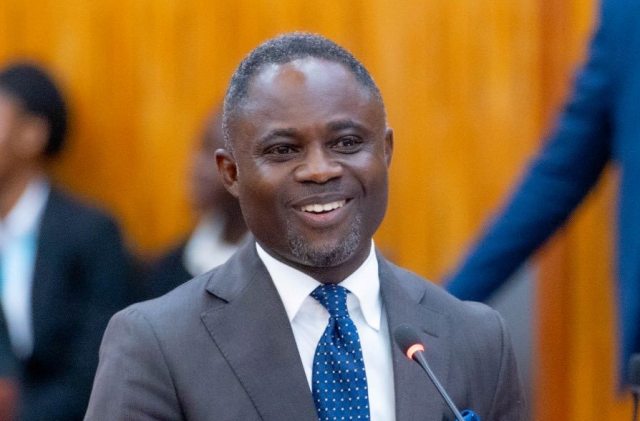

In a revelation highlighting the deepening crisis of healthcare workforce distribution, Minister for Health, Kwabena Mintah Akandoh, has expressed deep concern over the alarmingly low turnout of newly posted medical doctors across the country, particularly in the northern regions.
The Minister disclosed that data from the Ghana Health Service (GHS) revealed troubling disparities, with no newly posted doctors reporting to facilities in the Upper West (35 posted) and Upper East (32 posted) regions as of last Friday. The North East Region also reported a zero turnout out of 19 posted doctors.
“As of last Friday, the update on the posting of new medical officers across the country is not encouraging,” Akandoh stated when he addressed the media in Parliament on Tuesday on the status of the nationwide postings.
Also read: Parliament approves GH¢5.4bn to accelerate govt’s ‘Big Push’ infrastructure agenda
Mr. Akandoh was emphatic that the government’s new policy, which prioritises the deployment of medical officers to underserved districts, must be viewed as an imperative for national health equity, not a punitive measure.
“Posting medical officers to districts should not be seen as punishment. It is an equitable distribution of our health workforce. We are posting doctors where they are needed most,” he insisted.
The urgency of this redistribution is underpinned by a disturbing imbalance, the Minister noted, citing that nearly 50% of all medical doctors in the country are concentrated in Greater Accra alone.
“That is scary,” he stressed, arguing that this urban concentration severely undermines national health equity.
The Minister announced a one-week grace period for all newly posted doctors to report to their assigned facilities. However, he stressed that the postings are non-negotiable.
“Unfortunately, there is no way we are going to change anything here. After one week, we will conduct validation. We expect them to report,” Akandoh stated, assuring that while his office remains open for dialogue on any challenges, the postings cannot be changed.
To address potential concerns and encourage compliance, the Health Ministry is actively engaging regional stakeholders, including District Chief Executives (DCEs), Members of Parliament (MPs), and traditional authorities, to ensure the new medical officers can “settle and work comfortably.”
Discussions are also underway to introduce incentives for the doctors. “Government will look at how we can incentivise them to give their best. Some arrangements, including accommodation, are already underway,” he disclosed.
Regional Reporting Breakdown (GHS Facilities Only)
The following statistics, representing only Ghana Health Service facilities, illustrate the national reporting challenge:
| Region | Doctors Posted | Doctors Reported | Reporting Rate |
| Upper West | 35 | 0 | 0% |
| Upper East | 32 | 0 | 0% |
| North East | 19 | 0 | 0% |
| Oti | 21 | 1 | 4.76% |
| Western North | 31 | 2 | 6.45% |
| Northern Region | 32 | 7 | 21.88% |
| Savannah | 19 | 7 | 36.84% |
| Ahafo | 21 | 8 | 38.10% |
| Central Region | 20 | 8 | 40.00% |
| Volta Region | 27 | 9 | 33.33% |
| Bono East | 25 | 11 | 44.00% |
| Eastern Region | 23 | 11 | 47.83% |
| Western Region | 37 | 14 | 37.84% |
| Bono Region | 37 | 15 | 40.54% |
| Greater Accra | 20 | 16 | 80.00% |
| Ashanti Region | 100 | 40 | 40.00% |