

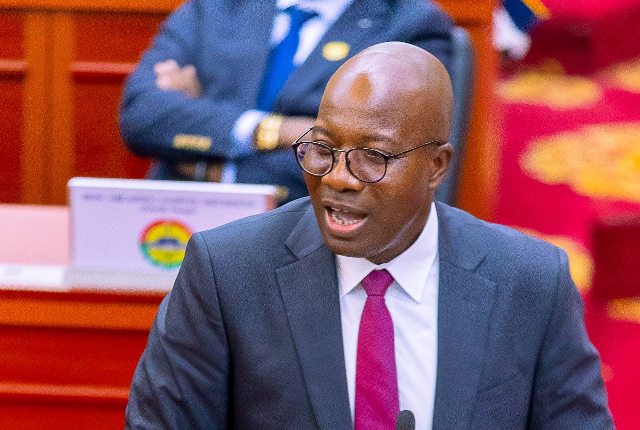

Majority Leader Mahama Ayariga has mounted a strong case for the abolition of the Office of the Special Prosecutor (OSP), describing the institution as ‘unconstitutional, confused, ineffective, and a failed experiment’ that has not achieved any significant results since its creation nearly eight years ago.
Speaking in Parliament on Thursday during consideration of the budget estimates of the Electoral Commission and the Audit Service, Ayariga cited the arrest and detention of private legal practitioner Martin Kpebu as fresh proof of an institution operating outside constitutional clarity.
Ayariga insisted that Ghana’s Constitution grants exclusive prosecutorial power to the Attorney General, not any parallel body.
Also read: Panbros Salt wins injunction as High Court slams Plaintiffs’ contradictory claims
“I opposed it. The Hansard will bear me out. I took the position that it is unconstitutional to strip the Attorney General of the power to prosecute criminal cases.”
Office of the Special Prosecutor
He called the establishment of the OSP a constitutional contrivance that attempted to appear legitimate even though it fundamentally conflicted with the country’s legal structure.
Ayariga questioned what tangible outcomes the OSP has produced since its formation.
“Mr. Speaker, tell me what the achievement of that office is. I cannot see any achievement. Major cases of clear corruption, up to date the office has not been able to do anything.”
He argued that political commitment, not the proliferation of new institutions, drives effective anti-corruption efforts.
He urged Parliament to restore clarity by empowering the Attorney General, the only constitutionally recognized prosecutorial authority.
“If the Attorney General is adequately resourced and protected by Parliament, that office will deliver.”
He argued that it was illogical that the OSP often receives similar or greater funding than the Attorney General’s office despite its limited impact.
Responding to Ayariga’s submissions, Speaker Alban Sumana Kingsford Bagbin reinforced the concerns, confirming that the OSP has always lacked constitutional grounding.
“If you recall, during the deliberation on the OSP, a number of us stated on the floor of this house that there is no constitutional basis. But we wanted to signal to the world that we are going to fight corruption.”
“At the end of the day, we have seen the results. We cannot continue to allocate such huge sums to the same office when we are not getting the results.”
Referring to ongoing constitutional review efforts, the Speaker said Parliament must rethink how state institutions are structured and funded.
He pointed to Standing Order 235, which mandates the Budget Committee to collaborate with the Ministry of Finance and the Presidency in shaping national budget priorities. He noted that many critical agencies, including Parliament itself, the Audit Service, and district-level bodies—remain severely underfunded.
“What is provided for Parliament is woefully inadequate… The audit service too is so inadequately funded that they cannot do the work required of them,” he stressed.
Bagbin warned that without proper realignment, Ghana cannot achieve meaningful democratic reforms.
“If not, please, let’s forget about real democracy or true democracy. We should stop deceiving ourselves.”
He also condemned the duplication of functions across agencies, including newly proposed audit units performing tasks already assigned to the Audit Service.
Bagbin highlighted the irony in budget allocations: “This is one of the agencies we should be looking at. It is getting almost the same amount as the Attorney General’s department. Please, let’s face the bull by the horns.”
He emphasised that the Attorney General, as a constitutionally established office, should receive priority funding.
Ayariga clarified that shutting down the Office of the Special Prosecutor would not shield any corrupt individuals and stressed that ongoing cases can continue under the Attorney General.