

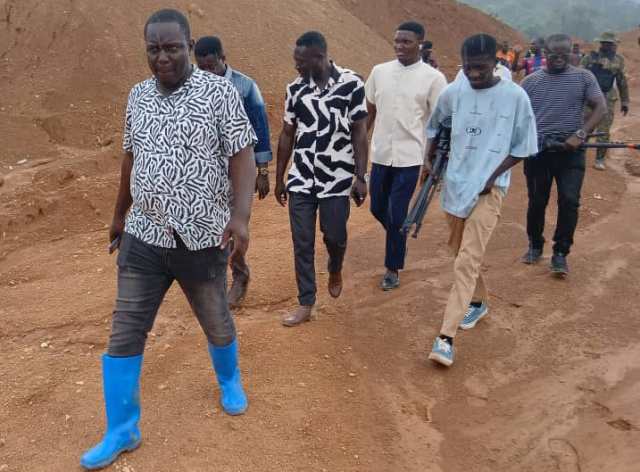

The Atiwa East District Chief Executive (DCE), Owusu Ntim Ernest, has launched a bold, no-nonsense land reclamation exercise, pioneering a policy to hold small-scale and illegal miners (galamseyers) directly accountable for the massive environmental degradation within the district.
The initiative aims to reverse the overwhelming destruction—characterised by abandoned, scattered pits that have ravaged farmlands and threatened the district’s core agricultural economy.
“The destruction within the district was huge. Our people are into agriculture, and there were pits all over the place. As an assembly, one of the legacies I want to leave behind is to introduce sustainable mining,” Mr. Owusu Ntim Ernest declared on Saturday during a media tour of already reclaimed sites.
Also read: Daddy Lumba was a ‘prophet,’ Ghana must honour him – Atiwa East DCE Ernest Owusu
Rejecting the option to simply complain, the Atiwa East District Assembly adopted a decisive policy approach by establishing a dedicated local task force to pinpoint those responsible for the destruction.
“As a leader, you don’t need to complain so much. You need to initiate decisions that will solve the problems you find yourself in,” the DCE explained.
The task force, sanctioned by the General Assembly, the Security Council and Management, has been mandated to identify every individual responsible for land destruction, map all degraded sites across the district, and retrieve personal details, including Ghana Card information. It is also tasked with compelling both past and present miners to return to affected areas and reclaim the lands they damaged.
“Virtually every pit has a name attached to it. A miner went there and caused that destruction. We have identified them, got their contacts and details, and we are calling them back for reclamation of the land,” the DCE stated unequivocally.
Mr. Owusu Ntim stressed that the immediate priority is environmental restoration, rather than immediate legal action.
“Before we can even prosecute them, we must first ensure that they correct the damage they have already caused to the environment. That is the main purpose of the task force,” he said.
He expressed confidence that Atiwa East is on track to become the first district in Ghana to fully reclaim galamsey-degraded lands, serving as a national blueprint.
Acknowledging that security efforts often falter after central military personnel withdraw, the DCE explained the necessity of local oversight.
“The military will come and do their best, but once they leave, sometimes after a week or two, activities resume. So who supervises after they have gone? That is why we decided to step in,” he noted.
The local task force ensures continuous monitoring and supervision within the district, guaranteeing sustainable enforcement.
Addressing potential defiance from illegal operators, the DCE issued a firm warning: “Once they encounter any opposition, they should call me or the command structure. Reinforcements will be provided.”
He confirmed that miners have been given strict timelines for compliance, failing which they will face judicial action. “We have told them clearly, if they fail to comply, we will take them to court. They must cooperate,” he warned.
Mr. Owusu Ntim clarified that the Assembly is not anti-mining, but anti-environmental abuse. “The major problem Ghanaians have with mining is not the gold itself, but how the environment is treated. If you do what is right, you are good to go,” he affirmed.
The next step, he said, involves a massive tree planting exercise and land-use planning, to be executed in collaboration with traditional authorities and the Physical Planning Department.
“We will work with the chiefs to decide where to plant trees and where to reserve land for future housing expansion, especially as towns expand,” he revealed.
Despite relying on Internally Generated Funds (IGF) for the resource-intensive programme, the DCE remains committed, assuring that this is a priority, and a mark he wishes to leave behind so that it becomes sustainable.