

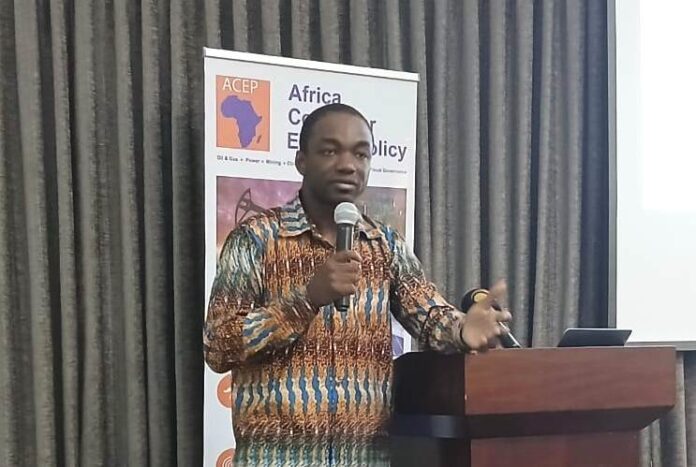

A Senior Policy Analyst at the Africa Centre for Energy Policy (ACEP), Dr. Charles Gyamfi Ofori, has called for deep structural reforms in Ghana’s power sector, warning that the Energy Sector Levies Act (ESLA) has not adequately addressed long-standing systemic challenges, ten years after its introduction.
According to him, while ESLA has helped mobilise funds to support the sector, it has fallen short of resolving fundamental weaknesses that continue to undermine sustainability.
Dr. Ofori made the remarks at a media roundtable to evaluate the effectiveness of the Energy Sector Levies Act (ESLA) in Ghana since its implementation in 2015.
“I think it’s short of addressing various systemic issues that plague the power sector. We really need serious reforms,” he stated.
Also read: Parliament approves 24-hour Economy Authority Bill
Dr. Ofori revealed that Ghana’s power sector debt remains a major concern, noting that as of March 2025, outstanding obligations stood at about $3.1 billion.
He explained that most of the funds generated under ESLA have been used to service interest payments and settle legacy debts, rather than to fix structural inefficiencies.
“All of these funds have been used to service some debt interest and others. How do we restructure the whole programme to tackle the issue head-on?” he questioned.
He also raised an alarm about persistent distribution losses, which continue to drain revenue from the sector.
“In 2015, when ESLA was introduced, we had losses of about 23 per cent. As of March 2025, we are still recording losses in the twenties,” Dr. Ofori disclosed.
The ACEP analyst cautioned against relying solely on increased levies and financial injections to rescue the energy sector.
“We can add a lot of money to ESLA, but that is not necessarily the biggest thing that can change the future of the power sector,” he said.
He stressed that without addressing inefficiencies, leakages, and weak management systems, additional funding would have a limited impact.
“In the face where structural issues are not dealt with, you will continue to do restructuring, but that may not necessarily solve the challenges,” he added.
Dr. Ofori identified distribution losses, under-recoveries, and weak revenue management as key obstacles to sector stability.
He noted that poor performance by distribution companies continues to undermine government efforts to stabilise electricity supply and pricing.
“You still get a lot of under-recoveries. You still get structural defects. These are issues that must be tackled,” he emphasised.
He argued that reforms should focus on strengthening governance, improving procurement systems, and reducing political interference.
Dr. Ofori, however, welcomed recent efforts to consolidate ESLA-related funds into a single window for debt and shortfall management.
“We are happy to see the consolidation of the funds into one window to deal with the debts and shortfalls,” he said.
Nonetheless, he warned that administrative costs and management inefficiencies within ESLA-linked institutions still raise serious concerns.
Dr. Ofori urged policymakers to prioritise long-term reforms aimed at building a stable, efficient, and financially independent power sector.
“We need a power sector that is free from excessive government interventions and liabilities,” he said.
He added that only comprehensive reforms, backed by strong political commitment, can guarantee a reliable electricity supply and reduce the burden on public finances.