

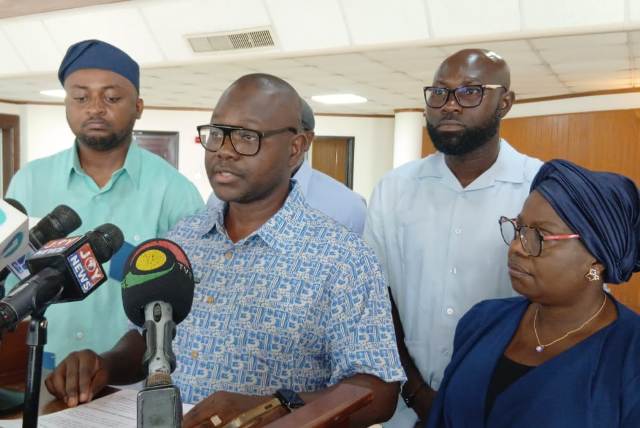

The Ashanti Caucus of Parliament has criticised the government’s decision to scale down the Suame Interchange Project from its original four-tier design to a two-tier configuration, describing the move as technically unsound and a disservice to Kumasi and Ghana.
Speaking on behalf of the Caucus on Monday, Member of Parliament for Bantama and former Minister for Roads and Highways, Francis Asenso-Boakye, said the decision undermines years of planning and threatens to worsen traffic congestion in the Ashanti regional capital.
“The reduction of the Suame Interchange from four tiers to two fundamentally compromises the integrity of the project and its ability to serve Kumasi’s long-term transport needs,” he stated.
The Minister for Roads and Highways recently announced that the scope of the project had been revised due to debt-related challenges and difficulties with contractor drawdowns.
Also read: The front pages: Tuesday, 10th February, 2026 newspapers
However, the Caucus rejected this explanation, arguing that funding limitations cannot justify what it described as a major technical downgrade of a strategically important project.
“If government could mobilise resources for projects such as the Ofankor–Nsawam Road, why is the Suame Interchange being shortchanged?” Mr. Asenso-Boakye questioned.
Why four tiers
The Suame Interchange was initiated under the administration of former President Nana Addo Dankwa Akufo-Addo to address worsening traffic congestion in Kumasi, Ghana’s second-largest city and a major national transport hub.
In July 2022, Parliament approved financing agreements backed by Deutsche Bank S.A. of Spain and the Spanish Export Credit Agency (CESCE), underscoring the project’s international credibility.
According to the Caucus, the four-tier design was based on detailed traffic modelling, engineering assessments, and long-term urban planning.
“This was not an arbitrary design. It reflected serious technical analysis aimed at addressing both current congestion and future growth,” Mr. Asenso-Boakye noted.
Under the original plan, Phase One included: A four-tier interchange at Suame Roundabout, an overpass at Krofrom Junction, an underpass at Abrepo Junction, and the widening of key sections of the Kumasi Inner Ring Road
Phase Two was to feature additional overpasses at Anomangye, Magazine New Road, and Abusuakruwa, dualisation of the Offinso Road, and construction of local roads.
The Caucus said detailed engineering designs for all four tiers were completed in 2024 after extensive utility relocations.
The Caucus warned that a two-tier structure will fail to resolve congestion and could turn the interchange into a major bottleneck.
“A two-tier solution will not eliminate conflict points, will not accommodate projected traffic growth, and will merely shift congestion from one junction to another,” Mr. Asenso-Boakye said.
He added that redesigning the project would lead to delays, cost overruns, and contractual disputes.
“In urban transport engineering, under-designing is often worse than doing nothing, because it locks a city into congestion for decades,” he cautioned.
The Ashanti Caucus raised concerns about what it described as inconsistent funding priorities.
The group cited the government’s ‘Big Push’ road programme, under which the Suame Interchange was listed in 2025 for guaranteed funding.
“The Finance Minister has said GH¢43 billion has been allocated to road infrastructure this year. Why can’t a fraction of this amount complete Suame as planned?” Mr. Asenso-Boakye asked.
The Caucus also questioned why new road projects are being initiated while existing ones remain incomplete.
Political discontinuity
The Caucus suggested that the decision may reflect a broader pattern of abandoning projects initiated under the Akufo-Addo administration.
“Is this government deliberately deprioritising projects it did not initiate? If so, it is ordinary Ghanaians who will suffer,” the statement said.
Describing Kumasi as a strategic national transit hub, the Caucus insisted the city deserves infrastructure that matches its importance.
“Short-changing Kumasi on a project of this scale is technically indefensible, economically unwise, and politically unjust,” Mr. Asenso-Boakye declared.
In its conclusion, the Ashanti Caucus urged the government to reverse its decision and restore the four-tier structure.
“We call on the government to reprioritise funding, restore the original design and engage transparently with Parliament and the people of Kumasi.”
“Kumasi deserves long-term solutions, not half-measures justified by selective constraints,” Mr. Asenso-Boakye said.