

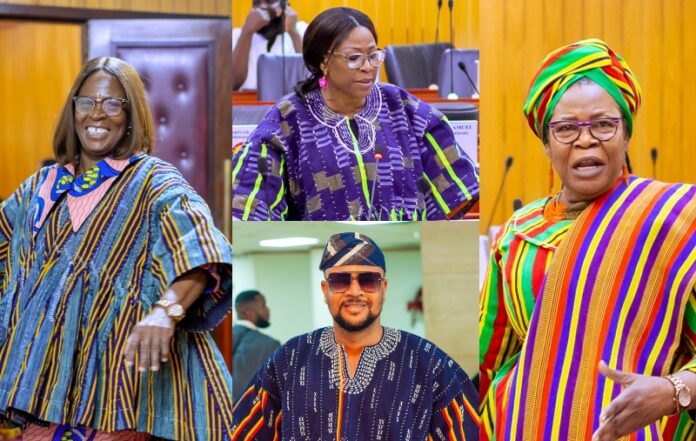

Members of Parliament have rallied Ghanaians to proudly wear the Fugu as a symbol of national identity, cultural confidence, and patriotism, urging citizens to embrace the iconic traditional smock not only during festivals and ceremonial occasions but also in everyday life.
According to the House, wearing Fugu reflects respect for Ghana’s heritage and affirms the country’s rich history, creativity, and cultural resilience.
The renewed call follows attempts by some Zambians to ridicule the attire after President John Dramani Mahama wore Fugu during his recent state visit to the southern African nation.
Also read: The Front pages: Thursday, 12th February, 2026 newspapers
Dr. Grace Ayensu-Danquah leads call for cultural pride
The Member of Parliament for Essikado-Ketan, Hon. Grace Ayensu-Danquah, who initiated the statement in Parliament, described Fugu as a powerful symbol of national unity, cultural pride, and heritage.
She said promoting the use of the traditional smock would help preserve indigenous skills, support local weavers, and strengthen national cohesion.
According to her, when Ghanaians confidently showcase their traditional attire, it sends a strong message of self-worth and cultural pride to the international community.
She urged the public to see Fugu not merely as clothing, but as a powerful expression of patriotism and shared identity.
Hon. Ayensu-Danquah traced the origins of Fugu to the northern savannah regions of Ghana, stressing the need to preserve and promote the fabric as part of the nation’s cultural identity.
She noted that although the attire is deeply rooted in northern traditions, it has evolved into a national symbol embraced across all regions.
According to her, the tightly woven patterns and distinctive designs represent strength, authority, unity, and cultural pride.
“Today, Fugu is worn across the country during festivals, weddings, funerals and official functions,” she stated.
The Essikado-Ketan MP recalled that Ghana’s founding leaders, including the country’s first President, Dr Kwame Nkrumah, wore Fugu during major national events such as Independence celebrations.
She added that successive presidents and political leaders, regardless of party or ethnic background, have continued to showcase the attire.
She also commended President Mahama for promoting Ghana’s culture on the international stage, citing his recent appearance in Fugu in Zambia as an example of effective cultural diplomacy.
Hon. Ayensu-Danquah welcomed the government’s declaration of Wednesdays as National “Fugu Day” to encourage citizens to wear the traditional smock.
“This initiative will help deepen our appreciation of Ghanaian culture,” she said.
Isaac Adongo advocates industry growth
Contributing to the statement, the MP for Bolgatanga Central, Hon. Isaac Adongo, recalled that Fugu has been part of Ghana’s national identity since independence.
He noted that although some critics mocked the President’s attire in Zambia out of ignorance, President Mahama had long worn Fugu at major international platforms, including the United Nations.
He described the declaration of Fugu Day as a strategic move to energise the industry and support local weavers and traders.
According to him, the initiative would create jobs, boost incomes, and strengthen the local economy, especially in northern communities.
He therefore called on the government to provide practical support to artisans to meet the expected rise in demand.
Anyimadu Antwi calls for cultural confidence
The MP for Asante Akim Central, Hon. Kwame Anyimadu Antwi, said Fugu has always been admired wherever it is worn, both in Africa and internationally.
He noted its comfort and suitability for all weather conditions and urged Ghanaians to cherish their culture without waiting for political leaders to set the example.
He encouraged Members of Parliament to defend Ghana’s culture and leadership against unfair criticism, regardless of political differences.
According to him, Parliament must lead the cultural renaissance to inspire the rest of the nation.
Laadi Ayamba highlights cultural symbolism
The MP for Pusiga, Hon. Laadi Ayi Ayamba, stressed the cultural symbolism of Fugu colours and designs, explaining that different shades and patterns carry spiritual, social, and traditional meanings.
She noted that certain colours are reserved for queen mothers, spiritually mature individuals, and ceremonial purposes.
She also explained how traditional styles have evolved from simple wraps to modern tailored designs.
Hon. Ayamba stressed the importance of preserving hand-sewn Fugu, describing it as superior in quality and cultural value.
She said many artisans, especially women and young girls, rely on weaving for survival but lack adequate financial support. She therefore called for funding, training, and access to materials to help expand production.
Habib Iddrissu calls for cultural education
The Deputy Minority Whip and MP for Tolon, Hon. Habib Iddrissu, spoke on the cultural meanings behind how Fugu is worn among different ethnic groups.
He explained that dressing styles signify authority, respect, and identity, with variations across tribes.
He also highlighted how hats, colours, and accessories can represent wealth, influence, and social status.
Hon. Iddrissu stressed the need for cultural education to prevent misunderstandings and ridicule, such as those that followed the President’s appearance in Zambia.
According to him, greater awareness would deepen appreciation for the history and significance of Fugu, urging northern communities to take the lead in promoting cultural knowledge.