

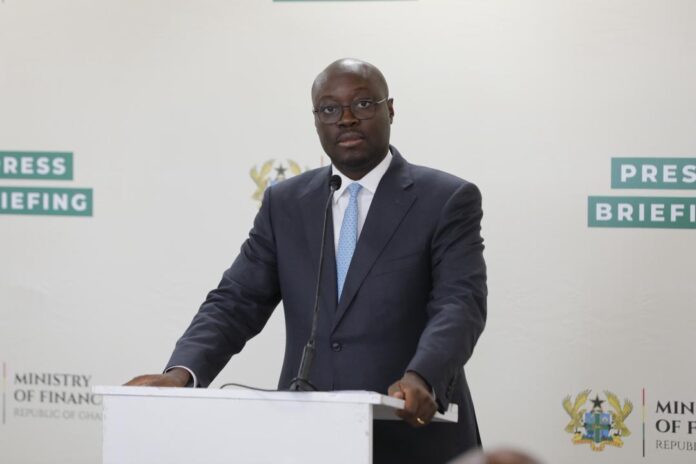

The Government has unveiled a new domestic bond financing scheme, dubbed the “Cocoa Bond,” to replace the collapsed syndicated loan and buyer-financed arrangements for cocoa purchases.
The initiative is aimed at addressing liquidity challenges and ensuring long-term stability, viability, and sustainability in the cocoa sector.
Announcing the policy at a press briefing on Thursday, the Minister of Finance, Cassiel Ato Baah Forson, said the new financing model would serve as a revolving fund to support cocoa purchases directly from farmers.
Also read: Mahama leaves Accra for Addis Ababa, Ethiopia for AU Summit
Under the arrangement, the Ghana Cocoa Board (COCOBOD) will raise funds from the domestic market, use the proceeds to buy cocoa, and repay the bonds from sales revenue within each crop year.
“The new financing model will utilise domestic cocoa bonds to purchase cocoa and repay from cocoa proceeds within each crop year,” Dr Forson stated.
He added that the scheme would also help revive indigenous licensed buying companies and strengthen local participation in the cocoa trade.
Background to the Reform
The announcement follows major challenges in the sector, including the collapse of COCOBOD’s 32-year-old syndicated loan system during the 2024–2025 season, which forced the adoption of a buyer-financed model.
Under that system, COCOBOD became heavily dependent on buyers’ willingness to pre-finance purchases, exposing the institution to global price fluctuations.
This vulnerability was worsened when world market prices dropped from an average of US$7,200 per tonne to about US$4,100 per tonne.
In addition, COCOBOD’s projected output of 800,000 tonnes for the 2023–2024 season fell sharply to 432,145 tonnes, representing a 45 per cent shortfall.
The deficit led to the rollover of 333,767 tonnes of contracts and losses exceeding US$1 billion.
As a result, COCOBOD struggled to meet payment obligations to farmers, prompting appeals from the Ghana National Cocoa Farmers Association for government intervention to clear outstanding arrears.
Boost for Processing and Value Addition
Dr. Forson said the Cocoa Bond scheme would also enable COCOBOD to sell beans directly to local processors, boost value addition, and create employment.
“The bonds will be issued as domestic bonds, called Cocoa Bonds, largely to finance cocoa purchases. They will sit on the balance sheet of the Ghana Cocoa Board,” he explained.
He assured that concerns about COCOBOD’s financial position were being addressed, adding that measures were already in place to strengthen its balance sheet.
“Beyond that, COCOBOD will be in a better place to enter the domestic market,” he said.
The Finance Minister further disclosed that the government would revamp the Cocoa Processing Company to spearhead domestic processing.
This follows a Cabinet directive that, from the 2026–2027 season, at least 50 per cent of Ghana’s cocoa beans should be processed locally.
Industry Welcomes Initiative
The President of the Licensed Cocoa Buyers Association of Ghana (LICOBAG), Mr. Samuel Adimado, described the Cocoa Bond initiative as a positive step.
“There is a saying that you cannot do the same thing and expect a different result. This is an opportunity to try a new approach for better results,” he told the Ghana News Agency.
He said the scheme, though broad in scope, presents significant opportunities to address long-standing challenges in the industry.
Mr. Adimado appealed to farmers to embrace the new model, remain patient, and seek clarification where necessary. He also urged the government to involve farmer leadership and other stakeholders in the implementation process.
On processing capacity, he noted that major industry players have established plants in Ghana with sufficient capacity to meet the proposed 50 per cent local processing target.
“This reform presents an opportunity for them to fully utilise their investments by processing cocoa locally,” he added.