

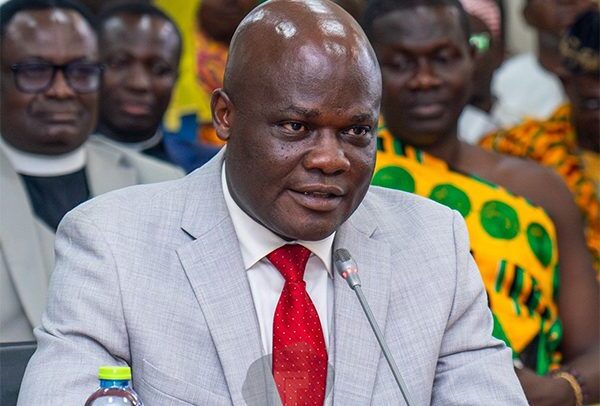

The Minister for Local Government, Chieftaincy and Religious Affairs, Ahmed Ibrahim, has defended the government’s policy of allocating 80 per cent of the District Assemblies Common Fund (DACF) directly to Metropolitan, Municipal and District Assemblies (MMDAs), stressing that a portion must be used to complete abandoned projects.
The policy, the Minister said, is aimed at ensuring balanced development and safeguarding public resources.
Speaking to journalists in Parliament on Wednesday, he explained that under the new arrangement, 80 per cent of the Common Fund is disbursed to assemblies, with at least 20 per cent of that amount earmarked for “legacy projects.”
“We said that at least 20 per cent of the Common Fund must be used on old abandoned projects started by our predecessors. That is what we mean by legacy projects,” he stated.
He clarified that legacy projects do not refer to current flagship programmes, but rather stalled developments such as markets, health facilities, school blocks, and administrative buildings.
“You cannot concentrate on new projects and abandon old ones. That is not development,” he added.
The Minister disclosed that all Metropolitan, Municipal and District Chief Executives (MMDCEs) have undergone orientation programmes, indicating that coordinating directors and finance officers are now receiving unprecedented levels of funding.
“Some assemblies are now receiving about two, three million, and even four million cedis. This has never happened before,” he said.
However, he cautioned that only five per cent of the funds is permitted for administrative expenses.
Hon. Ibrahim stated that the policy direction on legacy projects aligns with the vision of President **John Dramani Mahama**, who is determined to make his current term a legacy one.
“The President is serious. He wants these four years to be a legacy term, and that is why he insists on discipline and accountability,” he noted.
Addressing concerns over sanitation and ministerial workload, Mr Ibrahim said sanitation remains primarily a municipal responsibility.
He also defended the consolidation of ministries, arguing that it has reduced administrative costs and improved efficiency.
“What we suffered between 2017 and 2024 was high administrative cost. Now, fewer ministers are doing more work, and there is efficiency,” he said.
The Minister cited the cancellation of several controversial contracts as evidence of the government’s commitment to accountability.
He noted that some contracts, including fumigation and youth employment contracts, were cancelled to stop wasteful spending.
Mr Ibrahim also praised MMDCEs for their efforts, noting that many are working under pressure.
He added that the fear of reshuffles has compelled many officials to work harder.
“Everybody knows their job is at stake, so they are working very hard,” he said.
The Minister urged the media to assess government performance based on evidence. “Analyze the records, analyze the impact, and judge us fairly,” he appealed.
He reaffirmed his commitment to discipline, transparency, and grassroots development.