

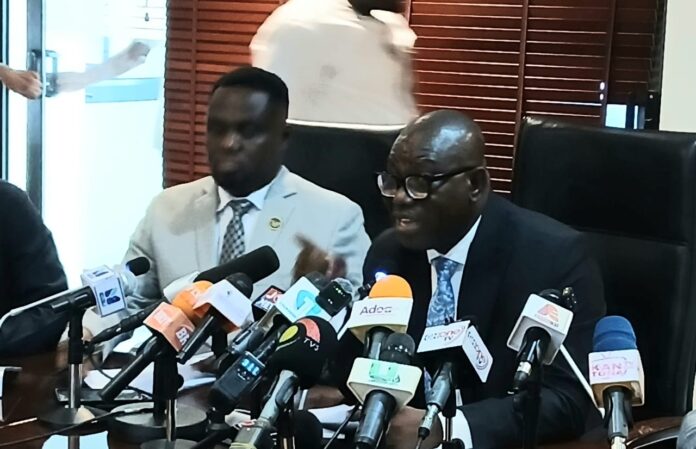

Member of Parliament for Bolgatanga Central, Isaac Adongo, has lambasted the management of the Ghana Cocoa Board (COCOBOD) under the administrations of Nana Akufo-Addo and Dr. Mahamudu Bawumia, accusing them of recklessness, incompetence, and financial indiscipline that pushed Ghana’s cocoa sector to the brink of collapse.
He revealed that COCOBOD’s net loss surged from GH¢283 million in 2020 to nearly GH¢6 billion in 2024, while liabilities more than doubled within the same period.
“This crisis did not come from nowhere. It is the product of years of debt accumulation, operational inefficiency, pricing distortions, and production decline,” he declared.
Addressing the media in Parliament on Thursday, Mr. Adongo accused the previous New Patriotic Party (NPP) administration of misleading cocoa farmers while undermining the institution meant to protect them.
Also read: NDC expels Umar Sanda for contesting as independent in Ayawaso East by-election
“They pretended to be helping farmers while systematically destroying the very institution meant to support them,” he said.
He stressed that before the National Democratic Congress (NDC) left office in 2016, COCOBOD recorded a positive net equity of about GH¢1.8 billion.
“By 2024, equity had collapsed to negative GH¢3.8 billion. Liabilities exceeded assets. That is financial ruin,” he stated.
According to him, the figures expose a legacy of mismanagement that can no longer be ignored.
Hon. Adongo disclosed that by January 2025, COCOBOD’s indebtedness had reached approximately GH¢32.9 billion, while total exposure, including operational liabilities, exceeded GH¢60 billion.
“This institution was bleeding—bleeding over 60 billion Ghana cedis—and some people still want us to borrow more. If your bucket is leaking, do you keep pouring water inside? Or do you fix the leak first? That is what we are doing now,” he said.
Mr. Adongo blamed excessive forward sales and over-commitment for worsening the financial crisis.
He explained that at the start of the 2025/26 season, COCOBOD had forward-sold about 530,000 tonnes—around 82 per cent of projected output—at an average FOB price of about US$7,200 per tonne.
While intended to hedge against price volatility, the strategy left Ghana dangerously exposed to market shocks.
He recalled that during the 2023/24 season, COCOBOD contracted 786,000 tonnes based on an expected production of 850,000 tonnes, but actual output fell sharply to 448,000 tonnes.
“We sold cocoa we didn’t have. We defaulted. And when you default, the country pays,” he said. He noted that the resulting penalties damaged Ghana’s credibility in the global cocoa market.
According to Mr. Adongo, the domestic debt crisis was worsened by an unprecedented collapse in global cocoa prices, which fell by nearly 70 per cent between January 2025 and February 2026.
He described the downturn as the worst in more than three decades, placing immense pressure on the sector. “These domestic and international shocks made structural reforms unavoidable,” he stressed.
Mr. Adongo announced that the NDC government had released GH¢855 million to clear outstanding obligations to farmers and stakeholders. “This morning alone, government released GH¢855 million to pay outstanding debts. That shows commitment,” he said.
He added that in February 2026, government initiated a comprehensive reset of the cocoa sector to restore financial stability and rebuild farmer confidence.
As part of emergency measures, Mr. Adongo said Cabinet has approved the conversion of about GH¢5.8 billion in legacy debt into equity-equivalent instruments.
“Debts owed to the Ministry of Finance (Ghana) and the Bank of Ghana will be converted into equity to restore positive net worth,” he explained.
He said the move would improve COCOBOD’s creditworthiness and end excessive borrowing.
Mr. Adongo also disclosed that GH¢4.35 billion in cocoa road liabilities had been transferred to relevant ministries.
“These roads should never have been on COCOBOD’s books. They were used to sink the institution,” he said.
The transfer, he noted, would enable COCOBOD to focus on its core mandate.
In a major policy shift, Mr. Adongo said government is abandoning foreign syndicated loans in favour of domestic cocoa bonds.
“This revolving finance mechanism will improve liquidity, pay farmers on time, and reduce external risks,” he stated.
He said the new model would ensure stable working capital throughout the season.
Beyond financial restructuring, Mr. Adongo said government is confronting deep-rooted governance failures, stressing that the era of cover-ups are over and those responsible will be exposed.
Mr. Adongo insisted that the reforms are aimed at restoring credibility and protecting farmers. “Our reforms are restoring discipline, realigning incentives, and rebuilding what others destroyed,” he said.
The restructuring, he said, would boost domestic processing and secure cocoa’s future and called on lawmakers to back the reform programme through swift legislative action.
“A strong COCOBOD is not optional. It is essential for millions of Ghanaians,” he said and stressed that cooperation with Parliament is critical to preventing a repeat of past failures.