

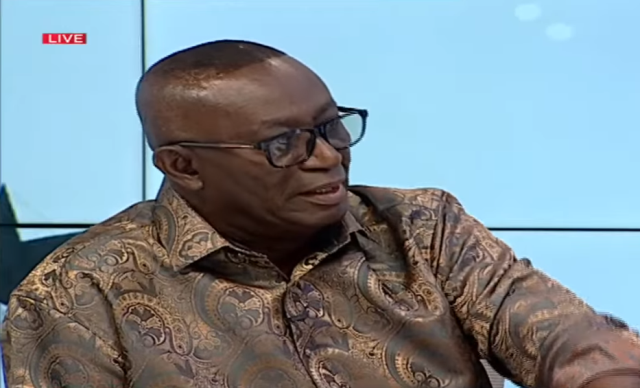

Former Member of Parliament for Asante-Akim North, Andrew Appiah-Kubi, has called for accountability over the mismanagement and political interference that have pushed the cocoa sector into crisis.
Speaking on TV3’s Saturday morning talk show, The Key Point, the former lawmaker stressed that public officers who mismanaged the cocoa industry must be held responsible, regardless of political affiliation.
“If people come into public service and misbehave, they must be put before the law. Political clothing should not protect anyone,” Appiah-Kubi said.
The former MP warned against politicising negligence in public institutions, saying it weakens governance and that, once politicised, it becomes a matter of NPP defending and NDC defending.
Also read: Ghana and Burkina Faso forge bold new security pact to confront threats of terrorism
He insisted that officials who exceed budget limits or approve unsustainable contracts must be sanctioned.
“Awarding contracts of about GH¢26 billion when your capital is almost the same amount makes no economic sense,” he stated.
Appiah-Kubi stressed that accountability must apply equally across parties, including the National Democratic Congress (NDC).
The former MP criticised successive administrations for abandoning the original vision of COCOBOD, particularly the creation of a stabilisation fund to protect farmers from price fluctuations.
“Income stabilisation meant creating a fund to insulate cocoa farmers against market shocks. That was neglected,” he stated.
He explained that the fund was meant to absorb price volatility and ensure financial stability for the industry, but governments instead diverted it for other purposes.
“The stabilisation fund became an avenue for raising money for other programmes, even when the industry itself was struggling,” he added.
Appiah-Kubi lamented that Ghana failed to benefit fully from record global cocoa prices between 2023 and 2025, when prices rose to nearly $11,000 per tonne.
“We had locked our prices, so we couldn’t cash in on the premium prices,” he noted.
He added that although forward sales were conducted, excessive focus on debt repayment limited the country’s ability to maximise revenue.
The former MP condemned the government for converting COCOBOD’s debts into equity, describing it as economically unsound.
According to him, the conversion of debt into equity is like using family resources to settle personal problems because it only weakens the system.
He stated that COCOBOD should have built sufficient reserves within its first few years to finance operations without resorting to heavy borrowing.
“We never expected COCOBOD to be borrowing. 79 years after formation, it should have had enough reserves,” he said.
Calling for long-term reforms, Appiah-Kubi urged policymakers to return to COCOBOD’s founding principles of sustainability, consolidation, and value addition.
“Let’s go back to the creation. What did we fail to do? Let’s correct it and do it well,” he urged.
He said future managers must also ensure adequate working capital, a strong stabilisation fund, and increased investment in processing and value addition, stressing that governance is about steady progress, not creating expectations that cannot be met.