

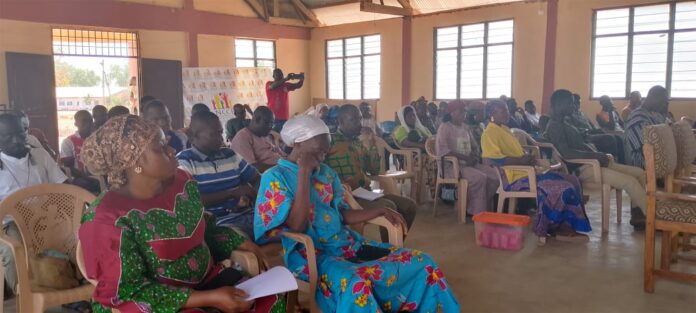

A cross-section of community members representing various stakeholder groups in the Sissala West District have been empowered to actively assess and monitor the performance of public institutions to promote transparency, accountability, and responsiveness in local governance.
The participants included duty-bearers, community leaders, women and youth groups, civil society organisations, persons with disabilities, and the media.
The engagement sought to provide a platform for dialogue between duty-bearers and residents to foster civic responsibility and participatory governance.
Also read: Minority accuses government of prioritising politics over economic reform
It was organised by the National Commission for Civic Education (NCCE) with support from Deutsch Desellschaft fur International Zusammenarbeit (GIZ) and co-funded by the European Union (EU) under a project dubbed: “Civic Engagement on the Rule of Law and the Fight against Corruption”.
The engagement also aimed at promoting community ownership of development projects and policies, enhancing citizens’ understanding of local government operations and the rule of law, and empowering residents to demand accountability from public officials.
Mr Mustapha Iddrisu, the Sissala West District Director of the NCCE, said social auditing platforms enable citizens to identify gaps in policy implementation, assess service delivery outcomes, and jointly develop action plans with local authorities.
He added that the approach strengthens accountability, promotes inclusive decision-making, and fosters shared responsibility for development.
“Social auditing offers a practical and participatory approach to strengthening the demand side of public accountability, empowering communities to access development projects, track the use of public resources, and engage duty-bearers in informed and constructive dialogue,” he stated.
Mr. Iddrisu noted that limited awareness of local government operations and weak interaction between citizens and the state continue to hinder efforts to demand accountability and monitor public service delivery.
He said the NCCE was therefore working to equip residents to address these gaps, which undermined public trust and adherence to the rule of law.
Mrs. Baidau Mohammed, the Sissala East Municipal Director of the Commission on Human Rights and Administrative Justice (CHRAJ), educated participants on public accountability, citizens’ rights, complaint procedures, and civic responsibilities.
She stressed that accountability builds trust and urged participants to seek information, monitor public office activities, question decisions, and engage duty-bearers through lawful participatory means.
Participants raised concerns about delays in infrastructure projects, the poor road network, sanitation challenges, inadequate classrooms, insufficient teachers’ accommodation, and shortages of educational materials, among others.
Mr. Gbene Abudu Fuseini, the Sissala West District Chief Executive (DCE), assured the participants of the Assembly’s commitment to transparency and accountability.
He reiterated that the Assembly was working to address key community priorities, particularly the construction of the Agenda 111 hospital and other critical development projects.
Reverend Father Sylvester Domayele of the Gwollu Catholic Church commended the NCCE and its partners for organising what he described as a “timely and reinforcing” engagement, saying such initiatives were crucial to driving development in the district.
He noted that empowering citizens in social auditing and civic engagement would strengthen accountability and accelerate development.
A five-member committee was formed to follow up on concerns raised and to demand accountability from duty-bearers in addressing the community’s identified needs.
GNA