
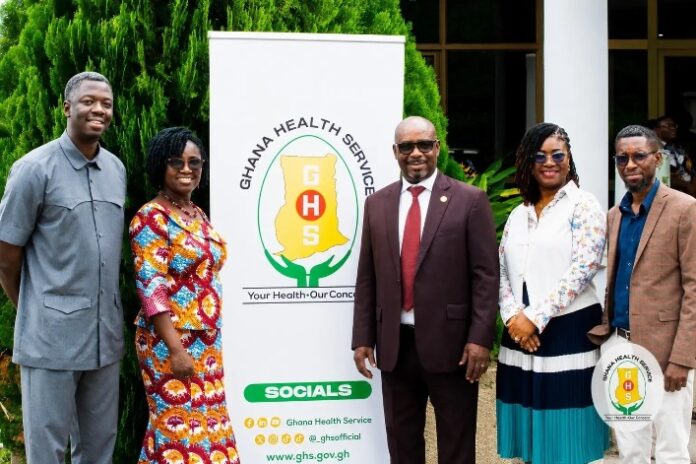

The Ghana Health Service (GHS), through its Health Promotion Division, has taken a major step towards strengthening the country’s response to misinformation, rumours and public concerns by introducing a structured Behavioural Intelligence and Infodemic Management (BIIM) System.
The initiative, developed in collaboration with the ECOWAS Regional Centre for Surveillance and Disease Control (ECOWAS RCSDC), aims to improve Ghana’s ability to detect, analyse and respond to misinformation while supporting evidence-based public health decision-making.
A three-day technical workshop, held to operationalise the BIIM system in Ghana, brought together Health Promotion Officers and key One Health stakeholders to build their capacity in behavioural intelligence and infodemic management.
Also read: The Front pages: Friday, 10th July, 2026 (Newspapers)
Speaking on behalf of the Director-General of the Ghana Health Service, the Acting Director of the Health Promotion Division, Mrs. Mabel Kisiwaa Asafo, stressed the importance of responding swiftly to misinformation before it undermines public confidence in the health system.
She noted that false information often spreads faster than verified facts, making early detection and timely intervention essential during disease outbreaks and other public health emergencies.
“Every rumour we fail to detect and address early has an impact on trust,” Mrs. Asafo stated.
She explained that the BIIM system addresses long-standing challenges, including fragmented systems and inadequate funding for monitoring public perceptions and misinformation.
According to her, the newly developed National Standard Operating Procedures (SOP) for Infodemic Management will provide a practical framework for implementing the BIIM system at the national, regional, district and sub-district levels. The guidelines will also facilitate the integration of information gathered from both online and offline community interactions to support timely public health interventions.
Mrs. Asafo encouraged participants to engage in the training actively, describing the workshop as an important opportunity to gain practical skills that will strengthen Ghana’s public health emergency response.
Representing UNICEF, Ms. Charity Nikoi urged participants to remain focused on the objectives of behavioural intelligence and infodemic management while working collaboratively across sectors. She encouraged regional officers to share the knowledge gained during the workshop with colleagues at the regional, district, and community levels to enhance nationwide preparedness.
The Executive Director of the ECOWAS Regional Centre for Surveillance and Disease Control, Dr. Mamadou Diarrasouba, described the workshop as a significant milestone in strengthening risk communication and infodemic management across Ghana and the wider ECOWAS region.
He observed that misinformation has become a major public health challenge capable of influencing health outcomes and public behaviour, making behavioural intelligence an essential pillar of emergency preparedness.
“Our focus on building resilient behavioural intelligence and infodemic management systems is both urgent and essential,” Dr. Diarrasouba said.
He explained that the initiative combines digital solutions, practical capacity building and institutional collaboration to strengthen national systems for risk communication and community engagement.
Dr. Diarrasouba commended the Government of Ghana, the Ghana Health Service and development partners for their commitment to establishing a sustainable national infodemic management system. He also acknowledged the National Public Health Agency of Sierra Leone for providing technical support, describing the collaboration as a strong example of regional partnership within West Africa.
The Behavioural Intelligence and Infodemic Management (BIIM) system was first introduced in Sierra Leone in 2023 and is designed to collect, analyse and interpret community perceptions, concerns and beliefs relating to health issues.
By transforming community feedback into actionable intelligence, the system is expected to strengthen disease surveillance, improve outbreak preparedness and response, enhance Risk Communication and Community Engagement (RCCE), promote public trust and reinforce One Health coordination across Ghana.
The workshop brought together officials from the Ghana Health Service, the Veterinary Services Department, the National Disaster Management Organisation (NADMO), the World Health Organization (WHO), UNICEF and other technical partners, reflecting a coordinated national effort to strengthen Ghana’s health security and improve resilience against misinformation during public health emergencies.