

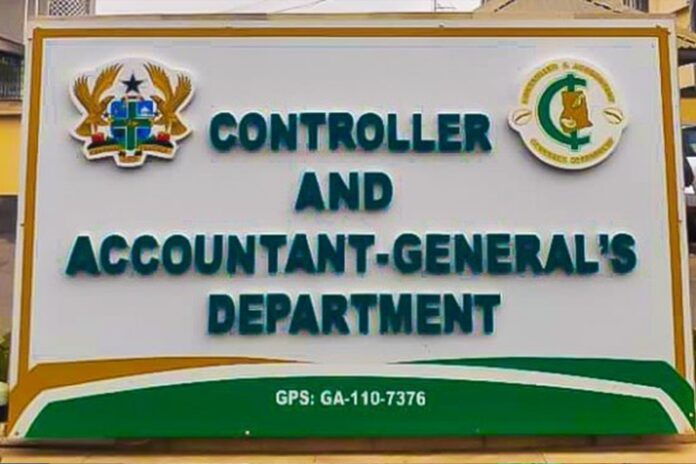

The Controller and Accountant-General’s Department (CAGD) has officially debunked New Patriotic Party (NPP) claims that the government has already spent nearly GH¢11 billion on the Accra-Kumasi Expressway project despite no visible construction work commencing.
The claims, according to the Department, are a gross misinterpretation of government accounting procedures and moved swiftly to set the record straight on the financial status of Ghana’s flagship road infrastructure project.
In a press statement dated Thursday, July 16, the CAGD stressed that the funds in question have not been released to any contractor and no money has been used for construction on the Accra-Kumasi Expressway corridor.
Also read: ‘Where did the GH¢10.92bn go?’ NPP demands full breakdown of Accra-Kumasi Expressway spending
The department explained that the government, through the Ghana Infrastructure Investment Fund (GIIF), established a Special Purpose Vehicle (SPV) – the Accra-Kumasi Expressway Limited – to implement the project. This entity is classified as a State-Owned Enterprise (SOE) for accounting and funding purposes.
“The claim that almost GH¢11 billion has been spent is false. These are approved budgetary allocations, not expenditures,” a CAGD source clarified.
The money
The CAGD revealed that following Parliament’s approval of the concession agreement, the government earmarked funds from the Annual Budget Funding Amount (ABFA) and mineral royalties in the 2025 Budget to support the project.
These approved amounts were transferred from the Consolidated Fund into a dedicated Bank of Ghana account—and that is where they remain.
“The funds have not been paid to any contractor or spent on construction works. They are safely held in the dedicated account pending project execution,” the CAGD stated.
Right-of-way clearing budget
The CAGD clarified that the ongoing right-of-way clearing being undertaken by the Ghana Armed Forces is a separate preparatory activity and is not financed from the Accra-Kumasi Expressway project funds.
This distinction is critical, the department stressed, to avoid public confusion about how public funds are being utilized across concurrent infrastructure preparations.
The Accra-Kumasi Expressway is one of the government’s most transformative infrastructure projects, expected to reduce travel time between Ghana’s two largest cities, boost trade and commerce, create thousands of jobs, and improve road safety on the busy N6 highway corridor.
By using an SPV model, the government aims to avoid delays, funding gaps, and cost overruns that have previously plagued similar public works.