

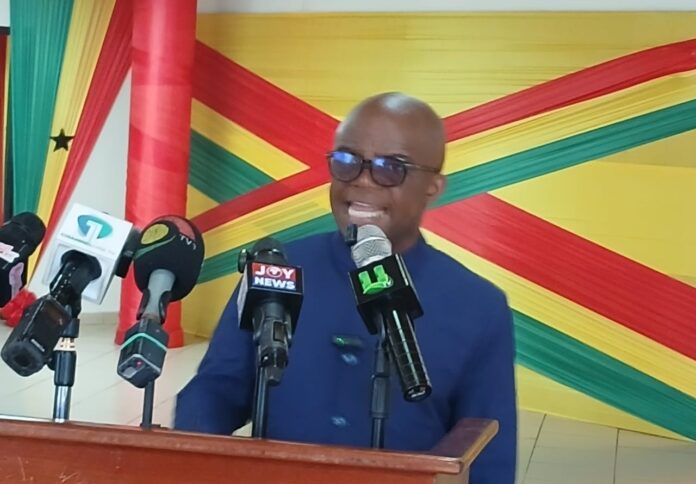

Nhyiaeso Member of Parliament (MP) Stephen Amoah has rejected his classification as a low-performing legislator in a recent assessment attributed to pollster Musa Dankwa of Global InfoAnalytics.
He expressed surprise at the assessment and challenged the methodology used to rank the performance of Members of Parliament, arguing that the core responsibilities of MPs must be clearly understood before their performance is evaluated.
Speaking on the matter during an interview in Parliament on Wednesday, the Nhyiaeso MP argued that parliamentary performance should be the primary basis for assessing legislators, rather than expectations relating to issues such as road construction, economic management and currency stability.
Also read: ‘Hubtel must answer for fraudulent Shortcode linked to me’ – Dr. China fights cyberbullying
“When it comes to MPs, your core function is what you do in Parliament. Let’s be very honest with ourselves,” Stephen Amoah said.
He argued that his record on the floor of Parliament, particularly his contributions to economic policy discussions and other national issues, should place him among the better-performing MPs.
According to Stephen Amoah, popularly called Sticker, he has made several parliamentary interventions and statements on issues he considers critical to Ghana’s economic development.
He cited his advocacy against government borrowing on the domestic market at high interest rates compared with private-sector borrowing, as well as his proposal for entrepreneurship education to be introduced into the curricula of Senior High Schools (SHS) and Junior High Schools (JHS).
The Nhyiaeso MP also said he had recently advocated a shift in Ghana’s economic policy approach from a free-market economy towards what he described as a mass-market economy.
Sticker said these interventions demonstrated his commitment to using Parliament as a platform to influence national policy and should be considered when assessing his performance.
Constituency projects
Beyond his work in Parliament, the Nhyiaeso MP listed several projects and initiatives he said he had undertaken to support his constituents.
He said he had facilitated more than 1,000 scholarships for students in his constituency, funded through a combination of his Common Fund, other resources and personal finances.
He also claimed that he had provided furniture, including tables and chairs, for about 2,400 schoolchildren in the constituency.
He urged any independent assessment of his contribution to education to include consultations with headteachers and teachers who, according to him, have firsthand knowledge of the support provided to schools.
The MP said he had also provided computers to secondary schools in the constituency and is preparing for a second round of computer distribution.
He further highlighted support for the rehabilitation and modernization of public schools, including the renovation of some dilapidated school structures.
According to him, some of the educational infrastructure projects had involved extensive reconstruction, including the replacement of roofing sheets, windows, doors and flooring.
He also referred to the construction of a new school facility at Adiebebeba, which he said could accommodate approximately 1,200 students.
Stephen Amoah said his constituency development efforts also included skills training and youth empowerment programmes and provision of logistics such as sewing machines.
Methodology
The Nhyiaeso MP questioned whether the assessment attributed to Musa Dankwa adequately captured the full scope of an MP’s responsibilities.
He argued that MPs should not be judged primarily on matters such as the performance of the Ghana cedi, national road infrastructure or broader economic conditions, because those areas largely fall outside the direct mandate of individual legislators.
“If currency stabilisation is not good, is it the MP? If the roads are not good, is it the MP?” he asked.
Stephen Amoah said such an approach could create a distorted picture of parliamentary performance and potentially mislead the public.
He stressed that MPs should be assessed based on their legislative and parliamentary work, their use of the Common Fund and their efforts to address the needs of their constituents.
Misinformation
Stephen Amoah warned that inaccurate information about the performance of public officials could have serious consequences for society because citizens rely on such assessments when making decisions.
“Misinformation is as toxic as anything at all you can think of,” he said.
He therefore called for greater care in evaluating and communicating information about the performance of MPs.
Researchers conducting assessments of parliamentary performance, he said, should engage directly with relevant stakeholders, including school authorities, teachers and constituents, to obtain a more comprehensive picture.