


The National Petroleum Authority (NPA) has announced revised fuel price floors for August 2026, setting new benchmark prices for petroleum products sold by Oil Marketing Companies (OMCs) across Ghana.
The revised ex-pump price floors, which take effect from August 4 to August 15, 2026, form part of the first pricing window for the month.
Under the new NPA fuel price floors, petrol has been pegged at GH¢14.53 per litre, while diesel has been set at GH¢14.97 per litre.
Also read: NPP secures police approval for August 6 protest over Sedina verdict
Liquefied petroleum gas (LPG) has also been priced at a minimum of GH¢11.06 per kilogramme.
Marine Gas Oil (MGO Local) has been set at GH¢16.08 per litre, while kerosene will sell at a minimum ex-pump price of GH¢14.46 per litre.
In a notice issued on August 3, the NPA reminded all Oil Marketing Companies (OMCs) and LPG Marketing Companies (LPGMCs) to comply with the revised petroleum price floors during the applicable pricing window.
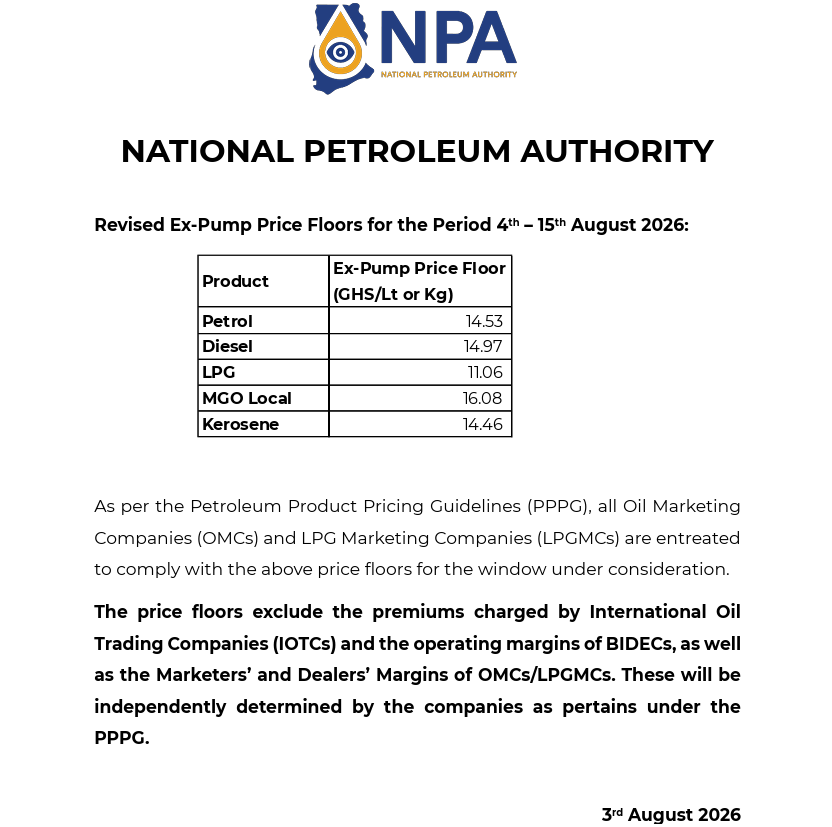
The Authority, however, clarified that the announced prices are minimum ex-pump price floors and do not include premiums charged by International Oil Trading Companies (IOTCs).
They also exclude the operating margins of Bulk Import, Distribution and Export Companies (BIDECs), as well as the marketers’ and dealers’ margins charged by OMCs and LPGMCs.
According to the NPA, these additional costs will continue to be determined independently by the respective companies in accordance with the Petroleum Product Pricing Guidelines (PPPG).
The NPA fuel price floors for August 2026 therefore serve as the benchmark for petroleum product pricing under Ghana’s petroleum pricing regime.
The new price floors are expected to guide retail fuel prices across the country during the first half of August, although the final pump prices charged by individual Oil Marketing Companies may vary depending on additional costs and margins.
The announcement comes amid ongoing developments in Ghana’s fuel market and recent government measures aimed at cushioning consumers against rising petroleum prices.
The NPA is expected to continue monitoring developments in the international oil market, exchange rate movements, and other factors that influence petroleum product pricing in Ghana.