

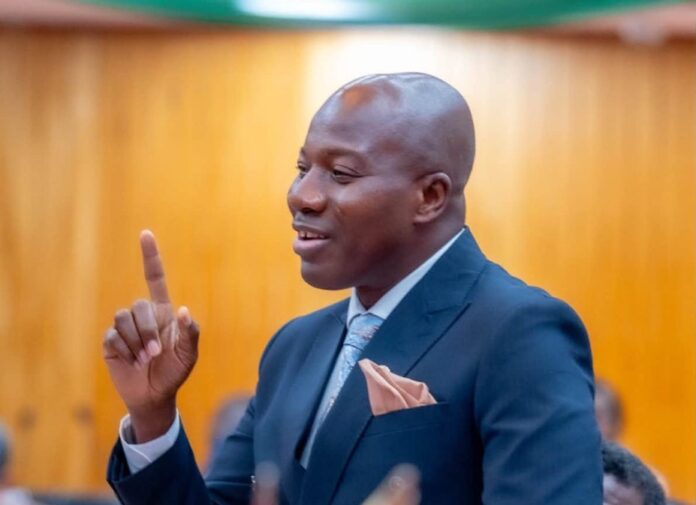

Outgoing Majority Leader Mahama Ayariga has mounted a strong defence of the Ghana Gold Board (GoldBod), rejecting claims that the institution’s operations contributed to a US$1.7 billion loss and arguing that the expenditure should instead be viewed as part of the cost of stabilising Ghana’s currency.
Speaking during Parliament’s emergency sitting on Monday, August 24, 2026, Mr Ayariga said the government’s gold-purchasing policy had delivered broader economic benefits, particularly by helping strengthen the cedi and supporting macroeconomic stability.
He criticised the Minority’s repeated characterisation of the reported losses, arguing that the figures should be assessed within the wider objectives of the Domestic Gold Purchase Programme.
Also read: Afenyo-Markin sues Sammy Gyamfi for GH¢15m over ‘extortionist’ allegation
“What you call losses are actually costs that this country has to pay to maintain the strength of our currency today,” Mr Mahama Ayariga said.
Mr Ayariga said the government has deliberately expanded gold purchases as part of efforts to build foreign exchange reserves, strengthen the cedi and stabilise the economy.
He pointed to developments in inflation, the exchange rate and Ghana’s international credit standing as indications that the policy was yielding results.
According to the Majority Leader, the increased volumes of gold processed through GoldBod also meant that the institution had to incur additional costs in carrying out its mandate.
Mahama Ayariga described the policy as “one of the best policies that have ever been implemented by any government in this country”, insisting that its broader economic impact should not be reduced to a single loss figure.
The GoldBod controversy intensified after the Minority, led by Alexander Afenyo-Markin, cited an IMF report indicating that Ghana’s Domestic Gold Purchase Programme recorded losses of about US$1.7 billion, equivalent to roughly GH¢22 billion, in 2025.
The Minority has called for a parliamentary investigation into the transactions and the financial implications for the Bank of Ghana (BoG).
However, the government has challenged the interpretation of the figures, with officials arguing that the programme’s costs were incurred in pursuit of broader monetary and economic objectives.
Mahama Ayariga also referenced concerns raised by the International Monetary Fund (IMF) and the World Bank, saying any losses arising from the arrangement should ultimately be borne by the government rather than the central bank.
He said reforms were already being pursued to move the transactions from the Bank of Ghana to the government.
GoldBod Chief Executive Officer Sammy Gyamfi has also strongly rejected claims that GoldBod itself incurred the reported US$1.7 billion loss.
Mr Gyamfi has described the allegation as false and pointed to GoldBod’s audited 2025 financial statements as evidence of the institution’s financial performance.
The statements reportedly recorded an operational surplus of GH¢907 million and an overall surplus of GH¢5.44 billion for the 2025 financial year.
The figures have become a major point of contention in the ongoing political debate, with the Minority focusing on the losses attributed to the Domestic Gold Purchase Programme while GoldBod maintains that its own accounts demonstrate a positive financial performance.
The disagreement has also escalated into a personal political confrontation between Mr Gyamfi and Mr Afenyo-Markin.
Mr Gyamfi recently described the Minority Leader as an “extortionist” during a media appearance, prompting Mr Afenyo-Markin to initiate a GH¢15 million defamation lawsuit against the GoldBod CEO and Multimedia Group Limited.
Despite the heated exchanges, Speaker Alban Sumana Kingsford Bagbin ruled that the Minority’s motion seeking an inquiry into the reported GoldBod losses could not be debated during the current emergency sitting.
Mr Bagbin explained that Parliament had been recalled by President John Dramani Mahama specifically to deal with three matters outlined in the President’s request.
He said Parliament must therefore restrict its business to those matters during the one-week emergency sitting.
The Speaker indicated, however, that the motion submitted to his office on August 21 would be admitted for consideration at the appropriate time.
That could eventually allow Parliament to examine in detail whether the reported US$1.7 billion should be treated as an actual financial loss, a policy cost or a combination of both.