

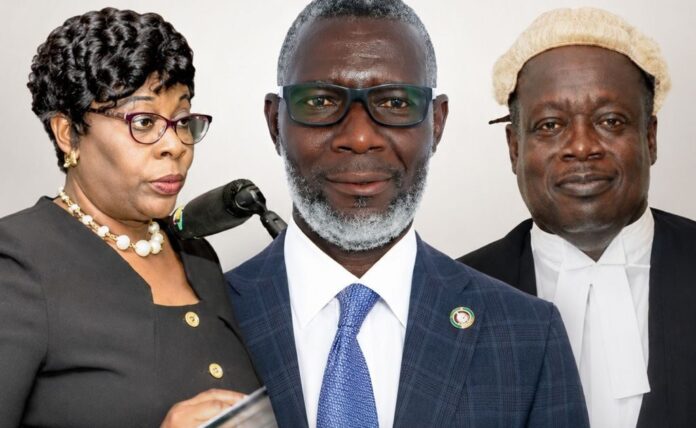

Parliament has approved the appointment of three Justice-designates to the Supreme Court despite strong objections from the Minority Caucus over the process used to vet the nominees.
The approval of the three Supreme Court nominees was secured by a majority decision at both the Appointments Committee and plenary levels.
The approved nominees are Justice Edward Amoako Asante and Justice Sophia Rosetta Bernasko Essah, both Justices of the Court of Appeal, and Anthony Forson Jr., a private legal practitioner.
Also read: Front Pages: Top newspaper headlines for Saturday, 29th August, 2026
Their approval on Thursday followed the presentation of the report of Parliament’s Appointments Committee by its Chairman, Bernard Ahiafor, who is also the First Deputy Speaker.
Mr Ahiafor urged Parliament to adopt the committee’s report and approve the appointment of the three nominees to the Supreme Court.
Presenting the report, the Chairman disclosed that the Minority Caucus had raised preliminary objections to the vetting of the Supreme Court nominees during the public hearing.
He said the objections were addressed during proceedings, but Minority members subsequently staged a walkout.
According to him, the Minority members indicated that they had “washed their hands of the rest of the processes leading to the vetting of all three nominees.”
Mr Ahiafor said that after the vetting, the majority of members present and voting recommended that Parliament approve the three nominees.
He said the supreme court nominees had satisfied the constitutional requirements under Article 104, paving the way for Parliament to approve their appointments.
Explaining the Minority’s decision to oppose the approval, Minority Leader Alexander Afenyo-Markin said the Caucus had “good reasons” for its position.
According to Mr Afenyo-Markin, Parliament’s emergency recall, which ended on Friday, gave the Appointments Committee only three working days to vet five nominees for two of the most consequential categories of public office in Ghana.
Mr Afenyo-Markin explained that the objection was based on nine separate grounds drawn from the Constitution and the Standing Orders of Parliament.
However, he said the Chairman of the Appointments Committee dismissed the objection, prompting the Minority Caucus to withdraw from the proceedings.
“What this House is now asked to adopt is a report produced afterward by Majority members alone,” he said.
The Minority Leader stressed that the Caucus’ objection was not directed at the personal qualifications or integrity of the three nominees.
He urged Parliament not to interpret the Minority’s opposition to the process as opposition to the individuals nominated to the Supreme Court.
“Our objection, as I have already stated, has nothing whatsoever to do with the persons of Justice Sophia Bernasko Essah, Justice Amoako Asante, or Mr Tony Forson,” he said.
He added that the Minority had not questioned the character, competence or professional standing of any of the three nominees.
Mr Afenyo-Markin outlined the nine grounds on which the Minority had based its preliminary objection to the vetting process.
Despite the Minority’s opposition, Parliament proceeded to approve the appointment of Justice Edward Amoako Asante, Justice Sophia Rosetta Bernasko Essah and Anthony Forson Jr. as Justices of the Supreme Court.