

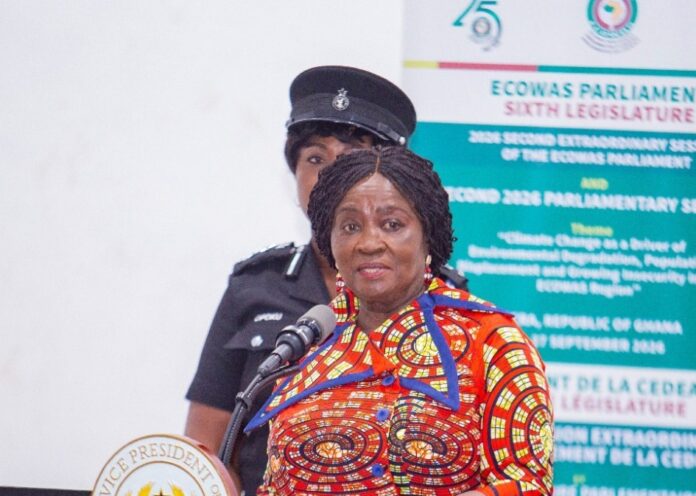

Vice President Prof. Jane Naana Opoku-Agyemang has called on members of the Economic Community of West African States (ECOWAS) to move beyond policy frameworks to practical action in tackling climate change, population displacement and growing insecurity across West Africa.
She said the interconnected nature of the challenges facing the region requires coordinated responses that address both their immediate effects and underlying causes.
Prof. Opoku-Agyemang made the call on behalf of President John Dramani Mahama at the joint opening of the ECOWAS Parliament’s Second Parliamentary Seminar and Second Extraordinary Session in Accra on Wednesday.
Also read: Ricketts-Hagan calls for stronger ECOWAS cooperation to tackle regional challenges
The seminar is being held under the theme: “Climate Change, Environmental Degradation, Population Displacement and Growing Insecurity in the ECOWAS Region.”
According to the Vice President, climate change and environmental degradation are having far-reaching consequences for livelihoods, food security and the well-being of people across West Africa, while population displacement and insecurity are compounding those pressures.
“The interconnected nature of these challenges requires unified responses,” she said.
She urged member states to develop coordinated regional approaches capable of responding to emerging threats before they develop into wider humanitarian crises.
ECOWAS must be felt in daily lives
Prof. Jane Naana Opoku-Agyemang said ECOWAS’ strength should ultimately be measured by the practical benefits it delivers to citizens.
“ECOWAS remains central to our region’s future. Its strength must be felt in easier trade, freer movement, wider opportunity and greater security,” she said.
According to her, improvements in border procedures, the facilitation of free movement and increased support for cross-border trade demonstrate the kind of cooperation required to make regional integration meaningful to citizens.
She said parliamentarians have an important role to play by bringing citizens’ concerns into regional decision-making, scrutinising the implementation of ECOWAS commitments and helping to build political support for effective policies.
The Vice President described population displacement as one of the most serious human consequences of the pressures confronting West Africa.
According to her, millions of people across the wider Sahel and neighbouring coastal states remain forcibly displaced or stateless, stressing that the crisis is regional in scale.
“Insecurity, environmental stress and disrupted livelihoods in one part of West Africa increasingly put pressure on communities and national systems in another part of the region,” she said.
She called for an integrated response combining security, development and climate resilience.
This, she said, should include stronger early-warning systems, better support for host communities, resilient livelihoods and improved coordination across national borders.
Youth opportunities key to peace
Porf Jane Naana also linked the region’s security challenges to the economic and social prospects available to young people.
She warned that prolonged exclusion and limited access to education, employment and decent livelihoods could create conditions that criminal and extremist groups might exploit.
“Creating opportunities, strengthening communities, investing in education and skills all amounts to investing in peace,” she said.
She urged ECOWAS countries to ensure that existing instruments covering free movement, disaster-risk reduction, climate action and early warning were fully implemented and adequately resourced.
Early-warning systems
Prof. Opoku-Agyemang disclosed that Ghana is working with ECOWAS to strengthen early-warning systems through improved data sharing, closer coordination and stronger links between national and regional response mechanisms.
The cooperation, she said, is improving the flow and analysis of information, enabling authorities to identify emerging risks earlier and respond more quickly and in a more coordinated manner.
However, she stressed that stronger systems and better coordination would require adequate resources and technical expertise to remain effective.
Climate finance
The Vice President also called for a stronger collective regional voice in securing climate finance and attracting investment into climate-resilient sectors.
She identified resilient agriculture, water management, coastal protection and clean energy as areas requiring practical investment.
She urged Members of the ECOWAS Parliament to contribute to efforts aimed at strengthening regional responses to the interconnected challenges.
Prof. Jane Naana Opoku-Agyemang reaffirmed Ghana’s commitment to the ECOWAS integration agenda and pledged continued cooperation with member states and Community institutions to advance peace, stability and prosperity across West Africa.
She expressed the hope that the seminar would produce practical recommendations for a stronger and more coordinated regional response to climate change, displacement and insecurity.