

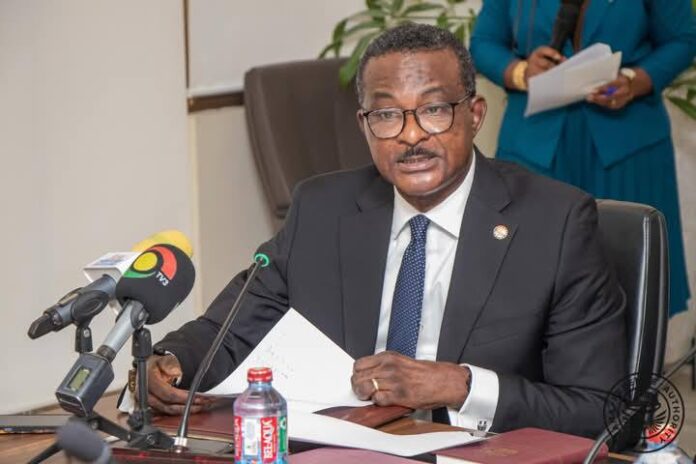

Former investment banker and Leader of Ghana’s delegation to the Economic Community of West African States (ECOWAS) Parliament, George Kweku Ricketts Hagan, has called on African countries to strengthen their capacity to develop bankable climate projects capable of attracting international carbon financing.
Mr. Ricketts Hagan said Africa and the ECOWAS sub-region are among the regions most affected by climate change but continue to struggle to take full advantage of available international climate finance.
Speaking in an interview at the just-ended Second Parliamentary Seminar and Second Extraordinary Session for 2026 last Saturday, he urged African financial institutions, governments, development finance institutions and investors to work together to develop climate-friendly projects that meet the requirements of international funding institutions.
Also read: IJM Ghana to Train Parliamentary Press Corps on child protection, human trafficking
“These funds have conditions we need to meet to attract that finance. It means we have to put together projects seen as bankable, meeting the criteria that will make it easy for the release of these funds,” he said.
Mr. Ricketts Hagan explained that international climate financing has created opportunities for countries to fund projects aimed at reducing greenhouse gas emissions and addressing the effects of climate change.
However, he said African countries need stronger technical expertise to turn these opportunities into actual bankable climate projects.
“We need these African financial institutions to work together with African governments, cooperation partners, and investors to build the expertise and capacity to develop these bankable climate projects,” he said.
According to him, well-prepared climate projects can also generate carbon credits, providing an additional source of revenue.
He explained that a carbon credit generally represents one tonne of greenhouse gas emissions reduced or removed through an eligible project and can be traded in carbon markets.
“This is one area where we are not actually doing well as a sub-region and continent. Yes, we have become victims of climate change, but there is now a provision to get some remedy from these carbon issues,” he said.
The former investment banker also questioned why some African institutions have struggled to utilise climate funds they have attracted.
He said while some people believe Western countries deliberately make it difficult for African countries to access financing, African institutions must also examine their ability to prepare projects that satisfy funding requirements.
Mr. Ricketts Hagan referenced discussions involving African development banks and financial institutions, where concerns were raised that some projects did not meet the conditions attached to available funds.
“As a former investment banker, I will actually not accept that argument. We need to build the expertise,” he said.
He pointed to countries in Asia, including China, which have successfully developed projects capable of attracting carbon-related financing.
“Why is it that on the continent and sub-region, these monies made available to us we have not been able to use? Is it because our preparation of these projects is poor and could be as a result of not having the kind of expertise?” he asked.
Mr. Ricketts Hagan said international partners should also help African countries develop the expertise required to meet climate financing conditions.
He criticised situations where governments announce billions of dollars in climate financing but later struggle to deploy the funds because projects are not sufficiently prepared.
“It’s unacceptable that we will attract this financing, make empty announcements about it, publish in papers that we have attracted billions of funds for climate-friendly projects, yet when the money hits our accounts we are not able to use it because our hands are tied,” he said.
He urged African countries to move beyond blaming industrialised nations for pollution and focus on building the capacity needed to benefit from available resources.
“We cannot continue to blame the industrialized world for polluting. We are looking at the way forward,” he said.
Mr. Ricketts Hagan stressed that Africa must develop its own expertise in preparing bankable climate projects, with governments, financial institutions and investors working together to turn climate financing opportunities into practical projects.