


Minority Leader in Parliament, Alexander Afenyo-Markin, has called for renewed stakeholder engagement on the future of the National Cathedral, arguing that the project could become a major religious, cultural and tourism landmark for Ghana.
Mr Afenyo-Markin said the National Cathedral should not be viewed solely as a religious institution but also as a potential national tourism and cultural asset capable of attracting visitors, showcasing Ghana’s heritage and contributing to the country’s tourism economy.
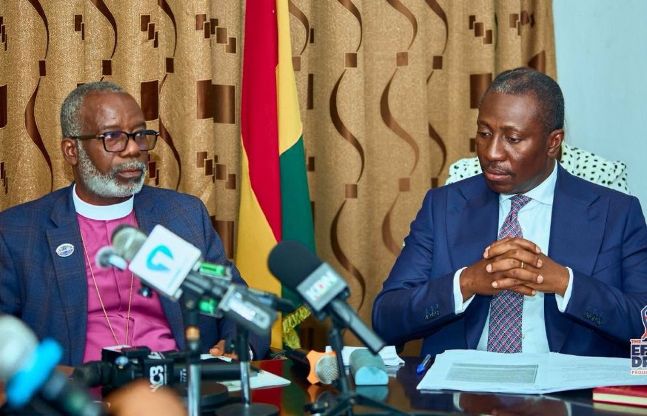
The Minority Leader made the call during a working engagement between the Minority Caucus and the Christian Council of Ghana, where discussions focused on national governance, accountability, political responsibility and the role of political actors in strengthening Ghana’s democracy.
Also read: Front Pages: Top newspaper headlines for Wednesday, 7th October 2026
According to him, the National Cathedral could follow the example of major religious and cultural landmarks in other countries that have become important tourist attractions.
He cited a recent training programme in Turkey, where he observed an old mosque attracting thousands of visitors daily for photographs and other tourism-related activities.
He said Ghana could similarly develop the National Cathedral into a major attraction that would draw visitors, promote the country’s cultural heritage and strengthen its tourism prospects.
“The National Cathedral should not be seen only as a religious project. We must also consider what it can do for tourism and for our national heritage,” he argued.
However, Afenyo-Markin expressed concern over what he described as a lack of clarity and consistency regarding the government’s intentions for the National Cathedral site.
He therefore called for broader consultations with relevant stakeholders to determine the project’s future and ensure decisions on the National Cathedral are guided by the national interest.
The Minority Leader said the engagement with the Christian Council was particularly important because it allowed the opposition to present its concerns directly to the Council.
“This morning you’ve given us a voice. At least you have heard us. We appreciate that,” he said.
Afenyo-Markin also welcomed the Christian Council’s call for political actors to maintain civility and dialogue despite their political differences.
“I take away from your remarks: disagree without becoming enemies,” he said.
The Christian Council of Ghana reiterated the need for political actors to work together on issues affecting the country, stressing that Ghana’s challenges and opportunities are shared by all citizens regardless of political affiliation.
Former Vice-Chairman and Executive Member of the Council, Bishop Dr Lawson Adjei, who received the Minority Caucus on behalf of the Chairman, urged political leaders to place national unity, responsible political engagement and the welfare of Ghanaians above partisan interests.
He called on politicians to promote unity despite their differences, warning that political competition should not turn opponents into enemies.
“Opposition should be strong, principled and courageous, but it should also be responsible and constructive. Our disagreements must never become greater than our commitment to the Republic,” he said.
“Let Ghana come first in all what we do. Let our politics be guided by the national interest, our criticisms by the desire to improve our country and our actions by the welfare of the Ghanaian people,” Bishop Dr Adjei added.