

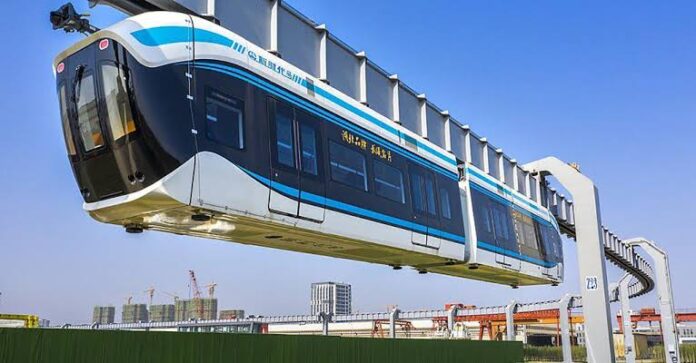

Former Minister and former Governing Board Chairman of the Ghana Infrastructure Investment Fund (GIIF), Professor Christopher Ameyaw-Akumfi, has mounted a comprehensive defence against criminal charges arising from the abandoned Accra Sky Train project, insisting that the controversial US$2 million transaction was a lawful and duly authorised equity investment.
Prof. Ameyaw-Akumfi is standing trial before the High Court (Criminal Division) in Accra alongside former GIIF Chief Executive Officer Solomon Asamoah in Case No. CR/0448/2025, The Republic v. Solomon Asamoah & Professor Christopher Ameyaw-Akumfi.
The two accused persons have denied wrongdoing in relation to the transaction.
Also read: Afenyo-Markin makes case to Christian Council for completion of National Cathedral
The defence position, contained in Prof. Ameyaw-Akumfi’s response, challenges the prosecution’s characterization of the 2019 payment as an unauthorised disbursement of public funds for a railway project that was never constructed.
According to the defence, the US$2 million was not paid for the construction of tracks, stations or other physical infrastructure. Rather, it represented an equity contribution that secured a 10 per cent shareholding in Ai SkyTrain Consortium Holdings (Mauritius), a special purpose vehicle established to undertake feasibility studies and structure the proposed multi-billion-dollar project.
The defence cites GIIF’s audited financial statements for 2019 and 2020, as well as bank transfer documentation, as evidence supporting its position.
Prof. Ameyaw-Akumfi’s case comes after trial judge Justice Audrey Kocuvie-Tay dismissed submissions of no case to answer filed on behalf of the accused persons and ordered them to open their defence.
The prosecution, led by Deputy Attorney-General and Minister for Justice Dr Justice Srem-Sai, has maintained that the 2019 transaction amounted to an unauthorised dissipation of public funds.
A central part of Prof. Ameyaw-Akumfi’s defence is the assertion that the investment went through GIIF’s established approval structures.
The defence points to records showing that the proposed equity contribution was first evaluated by the GIIF Investment Committee, which recommended the project development contribution at a meeting on September 28, 2018.
It further relies on minutes of the GIIF Governing Board meeting of October 24, 2018.
According to the defence, the minutes recorded the Board’s approval for US$2 million to be invested in the Accra SkyTrain project, with GIIF acting as the anchor investor in exchange for a 10 per cent stake.
The defence also cites a January 2019 addendum to GIIF’s budget estimates, which classified the SkyTrain project among “already Board Approved Projects” and provided for a US$2 million drawdown.
An emergency Board meeting held on November 19, 2019 also discussed the status of the project, with the defence arguing that the deliberations did not indicate that the investment had been regarded as unauthorised.
Prof. Ameyaw-Akumfi has also sought to distinguish his role as a non-executive Board Chairman from the day-to-day financial management of GIIF.
According to his defence, GIIF’s internal disbursement framework required joint signatures from the Chief Executive Officer and Board Chairman for expenditures exceeding GH¢500,000.
The defence maintains that payment requisitions were generated and processed by GIIF’s professional Finance Department before the transaction was executed.
It therefore argues that Prof. Ameyaw-Akumfi’s countersignature on the payment instructions was an administrative execution of an already approved institutional decision rather than an independent decision to release public funds.
The defence further points to testimony indicating that GIIF officers responsible for processing payments were required to ensure that appropriate Board authorisations and supporting commercial documents were in place.
Another significant element of the defence concerns the eventual failure of the SkyTrain project.
Prof. Ameyaw-Akumfi’s lawyers argue that the project’s development phase coincided with the COVID-19 pandemic and the global lockdowns that disrupted economic activity and international projects.
The defence contends that the circumstances surrounding the project’s collapse cannot automatically be converted into evidence of criminal wrongdoing.
It has relied on legal arguments concerning the requirement for the prosecution to establish deliberate malice, corrupt intent or reckless indifference in proving an offence involving the willful causing of financial loss.
The defence has therefore argued that unforeseen external events, including the pandemic and subsequent economic disruptions, affected the project’s implementation.
Prof. Ameyaw-Akumfi’s lawyers have also challenged the characterization of the US$2 million investment as a financial loss.
The defence says external audits conducted by firms including PricewaterhouseCoopers (PwC) and Deloitte & Touche did not classify the investment as dissipated or lost during his tenure.
It further relies on the Auditor-General’s report, which, according to the defence, recommended that GIIF continue to monitor the feasibility and recoverability of the investment rather than declaring the amount an unrecoverable loss.
The defence has also raised questions about the prosecution’s failure to call former Minister for Railways Development Joe Ghartey as a witness.
According to Prof. Ameyaw-Akumfi’s lawyers, the project originated through the Ministry of Railways Development, while responsibility for securing Cabinet and parliamentary approvals rested with that ministry under the relevant agreements.
The defence has questioned reliance on oral assertions attributed to the former minister by an investigator when Mr Ghartey’s signed statement contained only a brief denial of wrongdoing.
Prof. Ameyaw-Akumfi has further stressed that his tenure as GIIF Board Chairman ended in December 2020. He said that after a new Board was constituted in January 2021, responsibility for the Fund’s governance, oversight and management of investments rested with the new Board and executive management.
He has also denied personally benefiting from the SkyTrain project.
For Prof. Ameyaw-Akumfi, the defence is seeking to establish that the US$2 million transaction was an approved corporate investment executed through established GIIF procedures, rather than an unlawful diversion of public funds.