

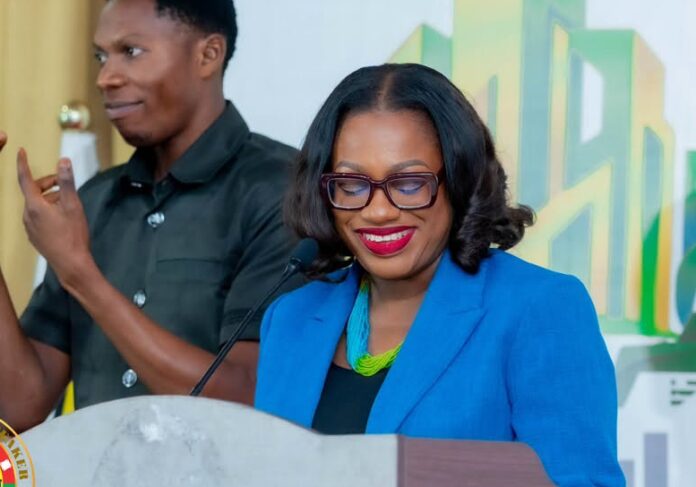

Auditor-General Dr Pamela Graham has disclosed that 10 State-Owned Enterprises (SOEs) owed the government GH¢3 billion in unpaid taxes, warning that Parliament must strengthen its oversight to ensure the outstanding liabilities are recovered.
She revealed that the Ghana Revenue Authority (GRA) recovered almost GH¢2 billion, representing approximately 67 per cent of the outstanding tax liabilities, between June and October 2026.
However, about GH¢1 billion remains outstanding, raising concerns about tax compliance among state-owned enterprises and the government’s ability to mobilise revenue from public institutions.
Also read: Bagbin sounds alarm over Parliamentary reports, demands action on Committee recommendations
Dr Graham disclosed this during her opening remarks at the 2026 Parliamentary Committees Leadership Training Programme, where she addressed the theme, “Parliamentary Oversight and Public Accountability.”
According to the Auditor-General, the figures of the unpaid taxes are contained in the Auditor-General’s 2025 Report on the Public Accounts of Ghana covering Ministries, Departments and Agencies (MDAs), which identified 10 SOEs as owing the government GH¢3 billion in taxes.
She explained that the disclosure provides an important example of why parliamentary committees must coordinate their oversight responsibilities rather than operate independently.
Dr Graham questioned whether the Public Administration and State Interest Committee, which is responsible for state-owned enterprises and state assets, is aware of the outstanding tax liabilities and the recovery efforts undertaken by the GRA.
She challenged the Finance and Budget Committees to examine the underlying causes of the unpaid taxes and determine whether government revenue is being properly accounted for.
“Is the committee trying to understand the root cause, so all Government revenue is properly accounted for?” she asked.
The Auditor-General further questioned whether sectoral committees are aware of the additional revenue available to the government and whether the Public Accounts Committee (PAC) is referring issues identified through its work to other relevant committees for follow-up.
“There is still GH¢1 billion of these taxes to collect from 10 SOEs,” she emphasised.
She urged committee leadership to promote collaboration, information-sharing and coordinated follow-up to ensure that audit findings translate into concrete action.
The Auditor-General stressed the Ghana Audit Service’s E-Tracker platform as an important tool for monitoring audit recommendations and tracking actions taken by public institutions to address identified irregularities.
She said greater use of the platform could help Parliament monitor outstanding audit matters, assess progress and identify recommendations that had remained unresolved.
According to her, effective oversight must go beyond identifying financial irregularities and issuing recommendations.
“Yes, audit findings must be examined. Yes, recommendations must be pursued. Yes, corrective actions must be implemented. And yes, where public resources are at risk, Parliament must continue to follow through until results are achieved,” she said.
She urged parliamentary committees to prioritise issues posing the greatest risks to public resources and service delivery while maintaining continuity in pursuing unresolved matters.