


Ghana’s economy expanded by 6.80% in August. It is the kind of number a finance minister would welcome on budget day: stronger than the 5.30% recorded in August 2025, above the 6.00% growth reported for the second quarter, and suggestive of an economy gathering speed.
But the figure comes with a harder question. If output is expanding, where is the growth occurring, who is benefiting, and how will the budget turn it into productive jobs and stronger household incomes?
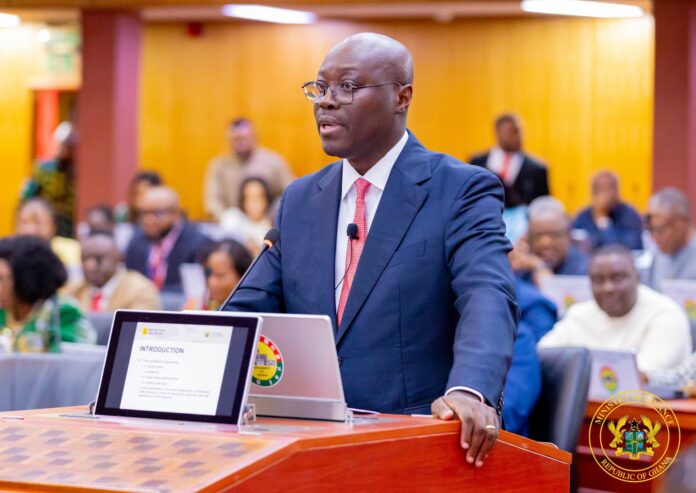
This morning, when the Finance Minister presents the 2027 budget under the banner of the “New Economy”, the headline growth rate will be only the beginning of the argument.
Also read: BoG reviewing three applications to operate non-interest banks
The latest Monthly Indicator of Economic Growth (MIEG), released by the Ghana Statistical Service, shows an economy moving forward but not evenly. Services grew by 10.70% in August and accounted for 69.90% of the total expansion. Industry grew by 4.50%, while agriculture grew by 2.60%.
The message for the budget is plain: Ghana’s growth is being carried chiefly by services, while the sectors expected to deepen production and transform rural livelihoods are advancing more slowly.
The New Economy has been presented as a four-year investment programme, with the government announcing an ambition to invest $10 billion between 2027 and 2030.
Its significance will depend less on the scale of the headline than on the machinery behind it: which projects are ready, how the programme will be financed, what role private capital will play and what measurable outcomes Ghanaians should expect in return.
A New Economy that cannot answer those questions risks becoming another name for aspirations whose delivery is left for a later budget.
That is why the August growth figure should be read carefully. MIEG is a volume index: it tracks changes in economic activity after adjusting for price changes. It is not a direct measure of incomes, wages, job quality or the cost of living.
The index reached 115.4 in August, from 108.0 a year earlier, but the latest figure is provisional; the series is experimental, and the data can be revised for up to two years. In its presentation, the GSS described MIEG as “an early signal, not the final word”.
There is good reason to take the signal seriously. In the second quarter, MIEG and quarterly GDP both showed growth of 6.00%, and the July–August average indicated growth of 6.90% for the first two months of the third quarter.
That gives the budget a timely reading of the economy’s direction before the full third-quarter GDP release, due in December. Yet the index’s limitations matter too: it is not seasonally adjusted, so it reports annual comparisons rather than month-on-month changes.
July’s estimate was revised from 7.40% to 7.00% after more data became available. A sound budget should use this evidence without treating an early estimate as an immutable verdict.
Services are the clear engine in the August reading. The sector’s 10.70% growth contributed 4.8 percentage points to the overall 6.80% expansion. Information and communication was identified as a major driver.
This is meaningful: communications, finance, trade and transport can expand business reach and create opportunities for investment.
But the growth rate alone does not tell us how many additional jobs were created, how much workers earned, or whether gains extended beyond a small group of firms.
That distinction matters on a day when the budget is expected to focus on economic transformation. Growth in a sector is not automatically inclusive growth.
To establish that services-led expansion is changing lives, the public will need clearer indicators of employment, productivity and income and evidence that those gains are reaching young people, women and businesses outside the largest urban centres.
The labour-market challenge makes that question concrete. The GSS has reported that close to two million people aged 15 to 35 were not in employment, education or training in the third quarter of 2025, equivalent to 19.50% of that age group. Youth unemployment averaged 21.90% across the first three quarters of 2025.
These are different measures: the NEET category also includes young people outside the labour force who are not studying or training. Both, however, point to the gap between economic activity and economic participation.
A budget cannot credibly claim to be creating opportunities simply because national output is rising. It must show how investment will connect young people to paid work, relevant skills and viable businesses.
That means asking not only how many projects will be announced, but how many jobs they are expected to create, how durable those jobs will be and what portion will go to people who are now excluded from work and training.
Industry offers a second test. Its 4.50% growth in August marked an improvement from 0.80% in August 2025, with manufacturing leading and mining and quarrying providing support. This is encouraging, but it is not yet the scale of expansion needed to establish a broad production base.
The question for budget policy is whether public investment will help businesses make and process more in Ghana, secure reliable infrastructure and build local supply chains, or whether projects will add capacity without enough links to domestic producers and workers.
Agriculture presents the most immediate warning. Its 2.60% growth in August was down from 8.60% a year earlier and 3.70% in July. The MIEG says crops led the increase, but the GSS presentation notes that livestock is not yet included in the agricultural measure.
The data therefore offer an important signal, not a complete account of every part of the sector. Even with that qualification, the slowdown should press the budget towards a clear explanation of how agricultural productivity, food supply and rural incomes will be supported.
The delivery question is already in the room. A pre-budget assessment of the 2026 statement lists GH¢302.46 billion in total expenditure, including GH¢57.53 billion in capital expenditure, and GH¢30 billion committed to the Big Push infrastructure programme.
It also points to announced agricultural initiatives such as Farmer Service Centres, Feed Ghana, oil-palm development, agricultural enclave roads, mechanisation and buffer-stock interventions, while arguing that the public needs an account of implementation.
These are claims in the assessment, not independently established project outcomes. The Finance Minister can address them directly today by publishing clear progress, expenditure and delivery information.
Without that account, the 2027 budget could add a new suite of programmes before the public knows what happened to the last one. The issue is not that a government must complete every announced project within a year.
It is that citizens and businesses need to see which commitments are funded, which are under way, what has been delayed and why. New projects should build on that record, not obscure it.
The government’s $10 billion New Economy ambition will draw attention to the question of scale. But the number will mean little unless the budget distinguishes public expenditure from investment the state expects to mobilise from other sources.
Is the figure a total investment target, a programme envelope, a financing commitment or a combination of these? How much will be funded directly from the budget? What role will private capital, development finance and state guarantees play?
Those distinctions are not technicalities. If public money is used to attract private investment, the budget should identify the conditions, expected returns and risks to the state. If guarantees or other contingent liabilities are involved, they should be visible.
If funding depends on projects becoming bankable, the budget should show the preparation work required to get them there. Clear answers would help investors distinguish an investable programme from a headline target.
The previous year’s budget scale offers a reminder of why this matters. Allocations are not the same as cash released, projects completed or value delivered. A capital budget can be large on paper yet struggle to translate into usable infrastructure if procurement, project appraisal and implementation capacity lag.
The New Economy will require more than a total investment ambition: it needs a transparent pipeline, milestones and institutions able to execute them.
The budget should also resist the assumption that productive investment means only roads, dams and power facilities.
Human capability is part of economic capacity. Teachers, health workers and social protection are often placed on the recurrent side of the ledger, but the people who use classrooms, clinics and safety nets make the workforce that businesses depend on.
The pre-budget materials make this point directly: social spending and economic policy are not separate accounts. A road without skilled workers, healthy families and functioning public services cannot deliver its full economic return.
This does not remove the need for fiscal discipline. The budget must show how it will pay for its priorities and manage competing demands. But a narrow focus on the classification of expenditure can make the state overlook investments whose returns arrive over time.
The practical challenge is to assess spending by what it accomplishes: whether a programme improves learning, health, productive capacity or access to work and whether its cost is affordable and sustained.
The August MIEG reading gives the government a strong opening figure: 6.80% growth, with the first two months of the third quarter averaging 6.90%. It also gives the Finance Minister a warning.
Services supplied almost seven-tenths of the expansion, agriculture slowed sharply from a year earlier, and the indicator remains provisional. The economy is growing; the composition and reach of that growth remain the harder questions.
A serious New Economy budget would make those questions measurable. It would connect investment proposals to sector outcomes, publish the funding structure behind the $10 billion ambition, set timelines for flagship projects and show how employment and productivity will be tracked.
It would report on previous commitments as carefully as it announces new ones. Above all, it would make clear how headline growth is expected to become work, income, food security and productive opportunity.
The Minister’s speech may define the programme’s priorities. Its credibility will be judged by what can be checked after the applause: money released, projects completed, firms expanding, young people working or training, and agriculture and industry adding more value to the economy.
Growth of 6.80% is a promising signal. The budget must show what Ghana intends to do with it.
The GSS’s closing reminder is a fitting standard for budget day: “Use it, question it, and hold us to it.” The same should apply to the New Economy.
NorvanReports