

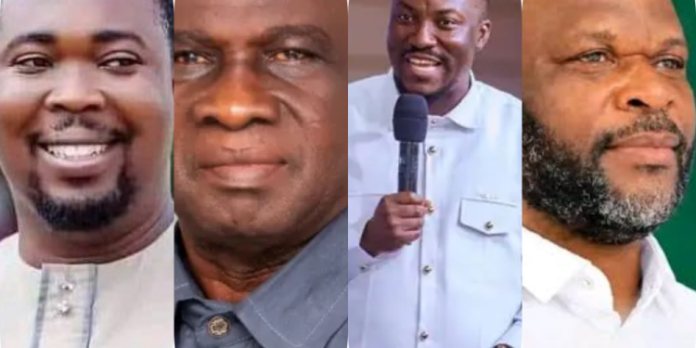

The National Democratic Congress (NDC) has elected regional chairpersons following its regional executive elections held on November 14, 2026, with several incumbent leaders retaining their positions and new faces emerging across the country.
The elections produced significant changes in some regions, including Greater Accra, where Benjamin Danso defeated incumbent chairman Emmanuel Nii Ashie Moore to become the party’s new regional chairman.
The results announced so far cover 15 of the 16 regions, with the Savannah Region yet to declare its winner.
Also read: Underrated exercises you’re probably not doing
The regional executive elections form part of the NDC’s preparations for its National Delegates Congress scheduled for December 19, 2026, when the party is expected to elect its national executives.
NDC regional chairmen: Full list of winners
Below is the updated list of NDC regional chairpersons elected following the November 14 elections.
| Region | Elected regional chairman |
|---|---|
| Ahafo | Owusu Nkrumah Ababio |
| Ashanti | Augustus Andrews Nana Kwasi |
| Bono | Kwadwo Nyamekye-Marfo |
| Bono East | Ali Abubakar Donkor |
| Central | Obeng Inkoom |
| Eastern | Mark Oliver Kevor |
| Greater Accra | Benjamin Danso |
| North East | Alhaji Abdul Rauf Tanko Ibrahim |
| Northern | Godfred Apasinaba Wumbei |
| Oti | Gabriel Kwame Emboe Samora |
| Savannah | Results pending |
| Upper East | Alhaji Abdulai Mumuni Bolnaba |
| Upper West | Adams Randy |
| Volta | Mawutor Agbavitor |
| Western | Nana Kojo Toku |
| Western North | Michael Aidoo |
Benjamin Danso topples Ashie Moore in Greater Accra
One of the biggest developments in the NDC regional elections was Benjamin Danso’s victory in Greater Accra, where he unseated incumbent chairman Emmanuel Nii Ashie Moore.
His victory represents a major change in the leadership of the party’s Greater Accra structure, one of the NDC’s politically significant regions.
In the Northern Region, Godfred Apasinaba Wumbei secured the chairmanship with 328 votes, defeating Alhaji Tanko Maida, who obtained 236 votes.
Ashanti Regional Chairman Augustus Andrews Nana Kwasi retained his position after polling 814 votes against 622 votes secured by former regional organiser Isham Alhassan Yaw Bonsu.
In the Upper East Region, Alhaji Abdulai Mumuni Bolnaba extended his long-standing leadership after securing another victory with a 220-vote margin.
Bolnaba, who has occupied the regional chairmanship since December 2005, defeated Duncan Nsoh Ghaneba, who polled 151 votes against his 371.
The Bono Region also recorded a decisive victory for Kwadwo Nyamekye-Marfo, who obtained 361 votes, representing more than 90 per cent of the votes cast. His opponent, Justice Samuel Adjei, managed 36 votes.
The contest was particularly significant because Nyamekye-Marfo had previously been elected unopposed in 2018 and 2022.
Central Region election attracts recount controversy
The Central Region election also attracted attention after incumbent chairman Richard Asiedu reportedly demanded a recount following reports that he had lost to Obeng Inkoom.
The outcome subsequently placed Inkoom on the list of elected regional chairmen, although the reported recount dispute makes official confirmation important.
In the Western Region, Nana Kojo Toku’s candidacy had attracted opposition from the Apinto royal family, which petitioned the NDC to prevent him from contesting.
The family argued that his status as a gazetted chief made him ineligible to participate actively in partisan politics under constitutional provisions governing traditional authorities.
Meanwhile, the Oti Region elected Gabriel Kwame Emboe Samora, while Adams Randy emerged as the new chairman of the Upper West Region.
The Savannah Region remains the only outstanding region awaiting the declaration of its regional chairman.
NDC turns attention to December National Congress
The regional executive elections represent an important stage in the NDC’s internal political organisation ahead of its National Delegates Congress on December 19, 2026.
The congress is expected to determine the party’s national leadership as it consolidates its structures following the regional executive elections.
With the emergence of new regional chairpersons and the retention of several incumbents, attention is now shifting to the national contest, which is expected to shape the party’s organisational direction.