

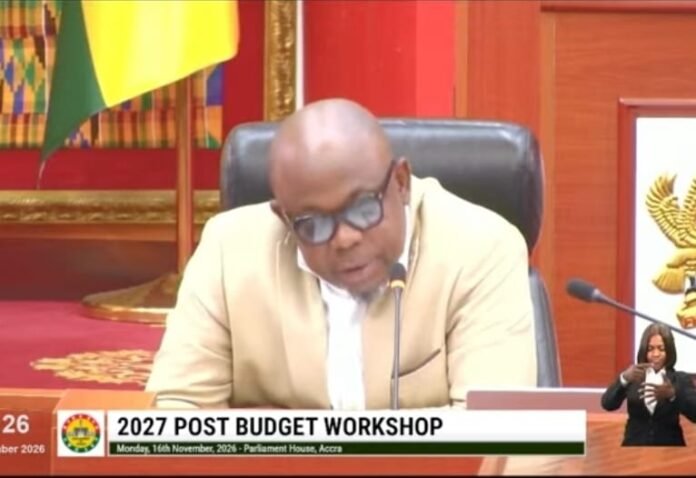

Members of Parliament (MPs) have been charged to set aside partisan rhetoric and anchor their upcoming debates on the 2027 Budget Statement and Economic Policy of the government on verifiable facts, objective evidence, and strict fiscal scrutiny.
Majority Leader and Member of Parliament for Builsa North, James Agalga, who made the call at the Post-Budget Workshop on Monday, reminded lawmakers that the session is not a “mere formality,” but the starting point of a critical constitutional duty to hold the executive accountable for its stewardship of the public purse.
“Let us remember that the weight of our decisions demands more than just passion; it requires objectivity and precision, and not partisan rhetoric,” the Majority Leader told MPs, Parliamentary Service staff, and resource persons during the opening ceremony.
Also read: ‘This isn’t the Rawlings party’ – Agbodza condemns vote-buying in NDC elections
“The people we represent deserve a discourse rooted in reality, not rhetoric,” he added.
The call comes days after the Minister for Finance, Dr. Cassiel Ato Forson, presented the 2027 Budget Statement and Economic Policy to the House on Thursday, November 12, 2026, on behalf of President John Dramani Mahama.
Under Article 179 of the 1992 Constitution, Standing Orders 195 and 201, and the Public Financial Management Act, 2016 (Act 921), Parliament is mandated to examine, debate, and approve the government’s fiscal policies and sectoral estimates.
Addressing lawmakers ahead of plenary debates and committee-level reviews, the Majority Leader emphasized that thorough, evidence-based scrutiny is essential to ensure that Ministries, Departments, and Agencies (MDAs) deliver value for money and implement programs strictly in line with parliamentary approvals.
He also challenged MPs to use the insights gained from the workshop’s sector experts to educate ordinary Ghanaians, helping citizens understand the government’s policy choices and form informed opinions.
As MPs prepare to dissect the estimates, they will be evaluating a budget focused on jobs, production, and economic transformation.
Key 2027 targets on the table include:
• Maintaining a positive primary balance of at least 0.5% of GDP on a commitment basis
• Keeping public debt consistent at 45% of GDP.
• Preserving single-digit inflation and strengthening external buffers.
Lawmakers will also weigh the government’s longer-term 2030 goals, which aim for an 8% real GDP growth rate, single-digit unemployment below 8%, and a path toward an investment-grade sovereign credit rating.
“We all stand to benefit from the positive outcomes that will accrue from the effective scrutiny and implementation of the budget,” the speaker concluded, urging full participation across all workshop sessions before the House reconvenes in the Chamber.