


Minister for Lands and Natural Resources, Emmanuel Armah-Kofi Buah, has taken a swipe at the previous New Patriotic Party (NPP) administration over the implementation of the Agenda 111 hospital project, claiming that despite an expenditure of GH¢4.8 billion, not a single facility was operational.
Mr Buah questioned the value delivered by the flagship healthcare infrastructure initiative under the administration of former President Nana Addo Dankwa Akufo-Addo.
He said the project had become an example of how public resources could be spent without delivering the intended benefits to Ghanaians.
Also read: Major healthcare boost: Gov’t to recruit 10,000 health professionals
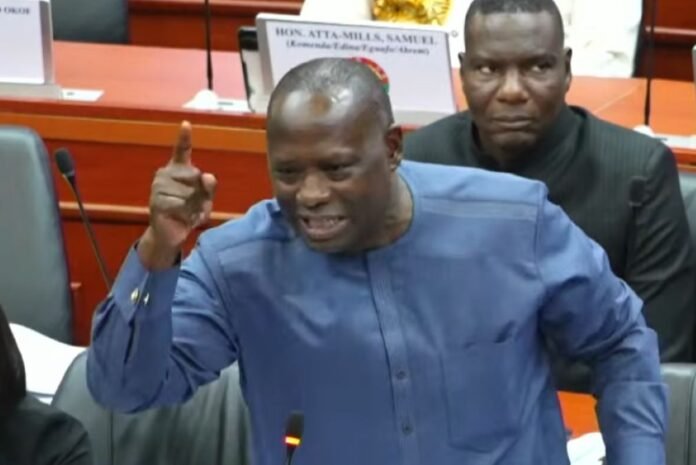
“I want to also make it clear that there’s no Agenda 111 in Juaboso. But the people of Ghana must know, and this has been said here, and I want to emphasize: this is a group of people, a government that spent 4.8 billion Ghana cedis on Agenda 111, and not one of them… not one was in operation, not one,” he told the House.
Speaking during the debate on the 2027 Budget in Parliament on Tuesday,
Speaking during the debate on the 2027 Budget in Parliament on Tuesday, he assured of a plan to restore public confidence, strengthen economic stability and transform Ghana’s natural resource sector.
Mr Buah praised Finance Minister Dr Cassiel Ato Forson for presenting what he called a “budget of hope”, arguing that the government had restored confidence in the country following the economic and debt crisis of 2022.
He said the administration of President John Dramani Mahama is seeking to convert the gains from macroeconomic stability into higher productivity, quality jobs and improved living conditions.
According to him, the 2027 Budget addresses longstanding weaknesses in Ghana’s economy, including commodity dependence, growth volatility and limited job creation.
According to him, the government’s proposed ‘new economy’ agenda is designed to move the country beyond the repeated cycles of economic expansion and crisis.
Turning to the natural resource sector, Mr Buah stressed plans to invest the equivalent of US$1.5 billion in local processing, Western Corridor logistics and efforts to end the export of raw minerals.
Ghana, he said, is targeting the local refining of at least 70 per cent of artisanal and small-scale gold by December 2027.
The government also aims to process at least half of its manganese and bauxite locally by the end of 2028, with full local processing targeted by 2030.
According to him, the proposed development of a critical minerals processing enclave in the Western Region, alongside the transformation of the Western Railway Line, would create jobs and reduce the transportation of raw minerals on Ghana’s roads.
He argued that the country must use its mineral and petroleum revenues to finance major transformational projects rather than spreading the resources across numerous smaller initiatives.
The Lands and Natural Resources Minister also defended the government’s efforts to combat illegal mining, popularly known as galamsey.
He disclosed that the 2027 Budget has allocated GH¢400 million for the reclamation of lands destroyed by illegal mining.
Mr Buah said approximately 8,900 hectares of land have been affected by mining activities, describing the damage as equivalent to about 12,500 football fields.
He reported that more than 200 acres of degraded land have been reclaimed during the year and said the government intends to intensify restoration efforts.
The minister also stressed plans to strengthen cooperative mining, train small-scale miners and expand community participation in protecting water bodies and forests.
He maintained that the 2027 Budget represents an opportunity to protect Ghana’s natural resources while creating a stronger industrial base and sustainable employment for young people.