

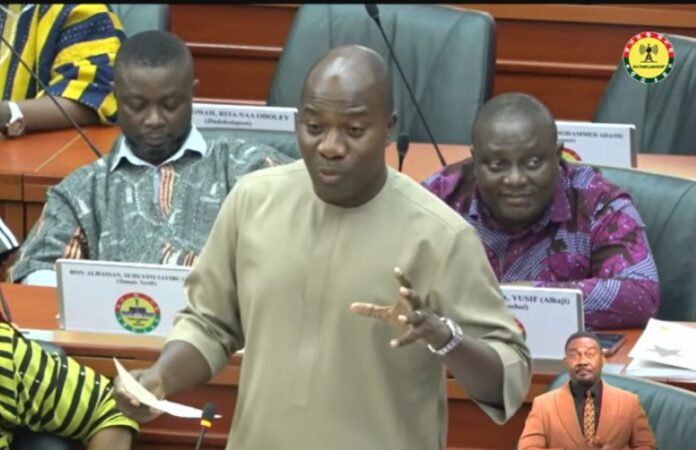

Minister for Local Government, Chieftaincy and Religious Affairs, Mahama Ayariga, has informed Parliament that Market women commuting from Kasoa to Accra Central are now spending less than 40 minutes on their journeys, down from about three hours, following the reconfiguration of the Aayalolo bus services.
The improved transport arrangement, which also covers commuters travelling from Adenta to Accra Central, forms part of President John Dramani Mahama’s efforts to ease urban congestion, improve productivity and provide better transportation for market women.
Speaking during the debate on the 2027 Budget Statement in Parliament on Wednesday, November 25, 2026, Mr Ayariga described the improved commuting experience as an example of what he called the President’s commitment to giving ordinary Ghanaian women “presidential treatment”.
According to him, commuters travelling from Adenta to Accra Central, who previously spent about two hours in traffic, now complete the journey in less than 25 minutes.
“Our women who used to spend three hours from Kasoa to Accra Central now spend less than 40 minutes to get to Accra Central. Our women who used to spend two hours from Adenta to Accra now spend less than 25 minutes,” he told the House.
According to the Minister, the Aayalolo buses have been reconfigured to improve urban mobility, particularly for market women who depend on public transportation to access commercial centres in the capital.
He added that the buses are now escorted by dispatch riders, drawing a comparison with the security arrangements accompanying the President’s official movements.
“They don’t just get there; they get there led by dispatch riders like the President. So our market women are now receiving presidential treatment,” he said.
Mr Ayariga said the arrangement is intended to make commuting more comfortable and less stressful for women who travel daily to trade and return home to attend to their domestic responsibilities.
He argued that shorter commuting times would allow market women to conduct their businesses more efficiently while spending less time exhausted by traffic congestion.
The Minister disclosed that President Mahama has tasked him with pursuing plans for a light rail infrastructure in Accra to address persistent congestion along major transportation corridors.
According to him, he is working with the Minister for Roads and Highways to develop the infrastructure plans for the proposed light rail system.
Mr Ayariga described urban mobility as a priority under the government’s broader development agenda, arguing that prolonged traffic congestion undermines productivity and economic activity.
The Minister also stressed the government’s investment in decentralisation, infrastructure development and sanitation under the 2027 Budget.
He disclosed that GH¢100 million has been allocated for the construction of waste transfer stations across the country, while another GH¢200 million has been earmarked for landfill development.
The Minister also announced that GH¢682 million has been provided for the construction of a new Agbogbloshie Market to accommodate traders, including yam and onion sellers currently operating in the area.
He further revealed that the government intends to direct at least 30 per cent of the GH¢10 billion earmarked for the District Assemblies Common Fund towards local economic development.
Under the proposed arrangement, Metropolitan, Municipal and District Assemblies would be permitted to use part of the funds to support young entrepreneurs, market women seeking to expand their businesses and artisans operating within their jurisdictions.
Mahama Ayariga said the measures form part of President Mahama’s broader vision of moving Ghana from economic stabilisation towards accelerated growth, job creation and improved living conditions.
He expressed confidence that the decentralisation programmes outlined in the 2027 Budget would translate into tangible improvements in communities across the country.