


The Minority Caucus in Parliament has accused the management of the Ghana Cocoa Board (COCOBOD) of orchestrating a deliberate cover-up by altering product names, batch numbers, and expiry dates to distribute over 60,000 litres of expired liquid fertilizer to unsuspecting cocoa farmers.
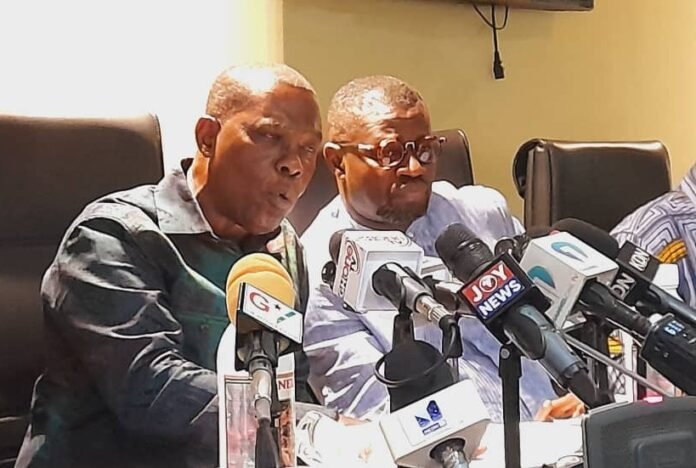
Addressing a press conference in Accra, the Ranking Member on the Food, Agriculture and Cocoa Affairs Committee, Dr. Isaac Yaw Opoku, described the alleged relabeling of the agrochemicals as an “economic sabotage” and a criminal act that threatens the 2026–2027 cocoa harvest.
Joined by Minority Chief Whip Frank Annoh-Dompreh, former Deputy Agriculture Minister George Oduro, and Jerry Ahmed Shaib, Dr. Opoku dismissed a November 25, 2026 press release from COCOBOD attempting to explain away the controversy as a “shambolic public relations attempt to cover up an institutional failure”.
Also read: Asafo-Adjei Ayeh exposes gaps in GH¢49.7m South Africa evacuation accounts, demands transparency
According to the Minority, physical bottles and photographic evidence obtained from cocoa-growing communities contradict COCOBOD’s official claim that the product in question Natural Asontem liquid foliar fertilizer—was manufactured in December 2024 with an expiry date of December 19, 2026.
Presenting sample bottles to journalists, Dr. Opoku stated that the original imported product, manufactured by Shanghai-based Helia Pesticides and Chemical Group Company Limited, was actually named Neutral Asontem under production reference number 20240210.
He revealed that the original labels clearly indicated a manufacturing date of February 10, 2024, and an expiry date of February 9, 2026—meaning the stock had expired over nine months ago while sitting undistributed in COCOBOD warehouses.
“Rather than absorb the financial loss caused by leaving the stock undistributed in warehouses, unscrupulous officials concealed the original date and allowed the expired product to be rebranded and pushed onto unsuspecting farmers,” Dr. Opoku stated.
He noted that the product name was altered from Neutral Asontem to Natural Asontem, the batch number changed from 2024021 to 20241220, and the expiry date extended to December 10, 2026.
“If the anomaly was genuinely detected earlier on, as COCOBOD wants us to believe, why try to alter the dates? Who supervised the relabeling? Where was it done? Was the Ghana Standards Authority involved?” he asked.
The Minority cited an internal circular from COCOBOD’s Cocoa Health and Extension Division (CHED), dated October 15, 2026 (reference CDFU/CHED/V3/26/147) and signed by Executive Director Dr. Richard Adu-Acheampong.
The memo reportedly instructed regional managers to ensure the prompt and complete application of Natural Asontem and another liquid fertilizer, Cocoset, ahead of a purported November/December 2026 expiration, warning of management sanctions against officers who failed to exhaust the stock.
Dr. Opoku said some regional managers only received the directive on October 29—just two days before November—triggering a frantic rush by field officers to pressure farmers into spraying the chemicals immediately.
According to distribution records cited by the caucus, 60,690 litres of the relabeled Asontem fertilizer have already been distributed across farming districts, alongside unverified quantities of Cocoset and completely unlabeled agrochemicals.
Warning that degraded organic fertilizers ferment in hot climates to produce toxic ammonia and pathogens that scorch cocoa leaves and abort young pods, the Minority insisted that COCOBOD cannot be trusted to investigate its own leadership.
The caucus outlined five immediate demands for the government:
• Immediate Halt: Order COCOBOD to cease all distribution and application of Neutral /Natural Asontem, Cocoset, and any unlabeled agrochemicals.
• Nationwide Recall: Recall every litre of the affected fertilizers distributed across all districts and communities.
• Laboratory Testing: Task the Cocoa Research Institute of Ghana (CRIG) and the Ghana Standards Authority (GSA) to conduct chemical, residue, and taint tests on the expired products and treated cocoa beans.
• Independent Probe: Institute an independent inquiry into the scandal to prosecute officials who sanctioned or facilitated the rebranding and distribution.
• Public Apology: Issue an immediate and unqualified public apology from the government and COCOBOD to Ghanaian cocoa farmers.
“COCOBOD cannot investigate itself in a scandal in which its own management is deeply involved,” Dr. Opoku stressed, adding that farmers deserve safe inputs rather than “degraded agrochemicals disguised through bureaucratic deception”.