

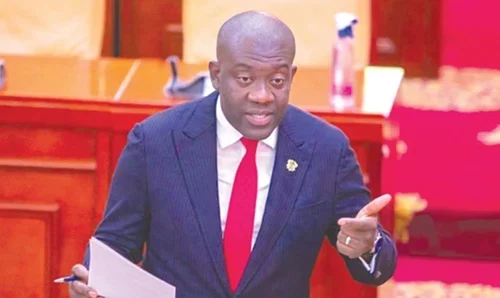

Ranking Member of Parliament’s Economy and Development Committee, Kojo Oppong Nkrumah, has cautioned that the 24-Hour Economy Authority will not create meaningful employment for Ghana’s youth.
He described the Authority as a misplaced priority that risks expanding bureaucracy without delivering tangible results.
Debating the Motion for the passage of the 24-Hour Economy Authority Bill last Thursday, the Ofoase-Ayirebi Member of Parliament argued that the legislation fails to reflect the government’s campaign promise of introducing a shift-based, round-the-clock working system.
“From Clause One to Clause 28, there is no mention of an around-the-clock working cycle. This bill does not deliver jobs,” he stated.
Also read: ESLA at 10: ACEP urges structural reforms to save Ghana’s power sector
According to him, the Bill does not provide a legal framework for the widely advertised “1-3-3” system, which was expected to promote three shifts per job and expand employment opportunities.
“They promised one job, three staff, three shifts, but it is nowhere in this Bill,” he added.
Mr. Oppong Nkrumah criticised the structure of the proposed authority, warning that it would mainly benefit administrators rather than ordinary workers.
“What this Bill sets up is a chief executive, a board, internal auditors, and hundreds of staff. That is not job creation for the youth,” he said.
He argued that the authority would require significant public funding while failing to stimulate productivity in key sectors such as manufacturing, logistics, and services.
The Ranking Member noted that several existing institutions already perform similar functions, making the new authority redundant and unnecessary.
“If it is about exports, GEPA is already there. If it is about incentives, the Finance and Trade Ministries are already responsible,” he observed.
Mr. Oppong Nkrumah also expressed concern about the legislative process, stating that Parliament considered the Bill before receiving the official policy document.
“We were asked to consider this Bill without the policy framework. That is building the first floor before the foundation,” he remarked.
He said the approach weakened parliamentary oversight and undermined confidence in the policy.
He further pointed out that public institutions earlier mentioned by the government as part of the 24-hour economy plan, such as the DVLA and Customs, were not captured in the Bill.
“None of these agencies is mentioned. If they are supposed to work 24 hours, they should be listed here,” he insisted.
According to him, without legally binding obligations, the authority would have limited power to enforce compliance.
Responding to government claims that thousands of jobs had already been created under the policy, Mr. Oppong Nkrumah challenged officials to provide verifiable evidence.
“Name one contractor working at 2 a.m. under this policy. This House is a house of records,” he said, warning that exaggerating achievements could erode public trust.
Despite his reservations, he said the Minority would not obstruct the bill’s passage but urged the government to reconsider its approach.
He called for a stronger focus on strengthening existing institutions, improving infrastructure, and creating incentives for private sector expansion.
“Real job creation will come from improving productivity, access to finance, and market opportunities, not from creating more offices,” he stressed.
Addressing concerns about the policy framework, Majority Leader Mahama Ayariga revealed that the 24-hour economy policy document had been inaugurated in July 2025, arguing that it did not necessarily require parliamentary approval.
Copies, he said, were made available to Members of Parliament to encourage informed debate, but he lamented that some MPs did not take time to study the document.
Mr. Ayariga described the legislation as a critical institutional framework for Ghana’s economic transformation and a major milestone in the government’s agenda to create jobs, particularly for the youth.
According to him, the 24-Hour Economy Authority will ensure effective coordination among ministries, agencies, and the private sector to make the policy work for the benefit of Ghanaians.
He added that the policy will stimulate investment, reduce unemployment, and improve productivity by encouraging businesses to operate in multiple shifts.
Parliament subsequently passed the Bill on Friday, paving the way for the establishment of a statutory body to coordinate and implement the flagship 24-hour economy policy aimed at boosting productivity, job creation, and industrial growth.