

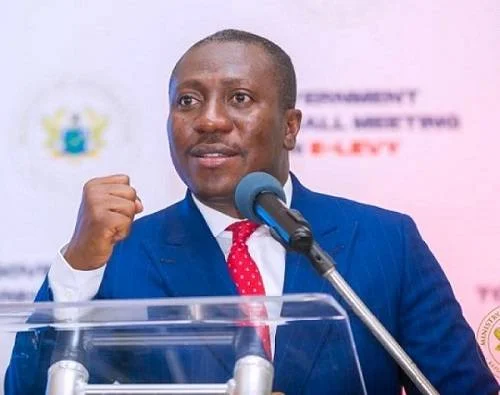

Minority Leader in Parliament, Alexander Kwamena Afenyo-Markin, has mounted a strong defence of the Danquah-Dombo-Busia political tradition, describing it as Ghana’s most enduring framework for liberty, constitutionalism, and citizen-led development.
The tradition, he said, is grounded not in the power of the state, but in the dignity and freedom of the individual citizen.
Delivering a public lecture on ‘The Danquah-Dombo-Busia centre-right ideology and its impact on Ghana’s socio-economic Development: A focus on the Kufuor and Akufo-Addo Governments, Mr. Afenyo-Markin said the tradition, now embodied in the New Patriotic Party (NPP), places the “free and empowered citizen” at the centre of national progress.
Also read: Akufo-Addo’s development blueprint still driving Ghana forward – Afenyo-Markin
Tracing the origins of the ideology to the United Gold Coast Convention (UGCC), Afenyo-Markin noted that the movement, which predates independence, has consistently championed constitutional governance.
He contrasted it with other political traditions associated with Kwame Nkrumah and Jerry John Rawlings, arguing that the Danquah-Dombo-Busia lineage has never seized power through force.
“We have won power at the ballot box, respected defeat, and upheld multiparty democracy,” he emphasized.
The Minority Leader cited the administrations of John Agyekum Kufuor (2001–2009) and Nana Addo Dankwa Akufo-Addo (2017–2025) as proof of the tradition’s impact on socio-economic development.
According to him, the 16 years of combined NPP governance demonstrated how private-sector growth, education, and social intervention can uplift ordinary citizens.
“These years provide the clearest empirical test of what this tradition produces when given the opportunity to govern,” he said.
Responding to criticisms that the tradition is elitist, Afenyo-Markin highlighted the sacrifices of its founders, including J. B. Danquah, Kofi Abrefa Busia, and Simon Diedong Dombo.
He recalled how Danquah died in detention, Busia lived in exile after a coup, and Dombo was imprisoned for his convictions.
“These are not the lives of men protecting privilege. These are lives devoted to service,” Afenyo-Markin stressed.
On the concept of property-owning democracy, Afenyo-Markin described it as a system that enables every citizen to become an economic stakeholder.
He argued that capitalism, in Ghana’s context, must be inclusive and supported by a state that removes barriers to opportunity.
“The goal is not to protect an elite. The goal is to destroy the barriers that keep people out,” he said.
Hon. Afenyo-Markin reaffirmed the NPP’s commitment to social mobility, education, and entrepreneurship.
He declared, “We are not a party for the few who have arrived. We are a movement for the many who are on their way.”
He added that the true legacy of the tradition would be found in “educated children, thriving small businesses, and improved living standards across Ghana.”