

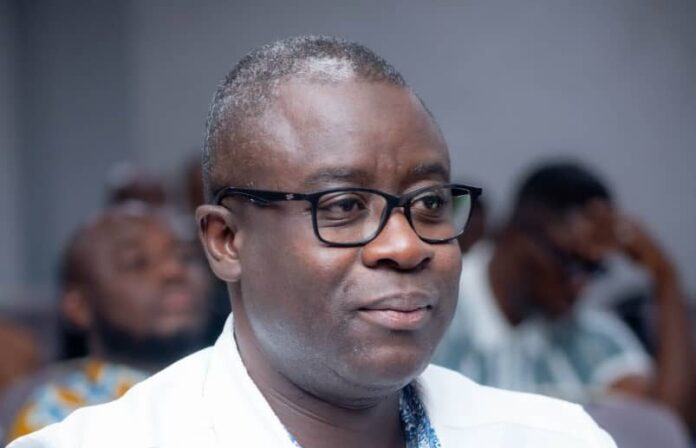

Member of Parliament for Wa East, Godfred Seidu Jasaw, has defended the State of the Nation Address (SONA) delivered by John Dramani Mahama, insisting that the government’s policies are already improving living conditions and strengthening Ghana’s agricultural sector.
Contributing to the SONA debate in Parliament on Wednesday, Jasaw criticised the Minority for focusing heavily on the cocoa sector and misrepresenting the realities facing farmers.
“Everything said today so far from the other side has had some mixture of cocoa. But the issues about the cocoa subsector are clear,” he said.
Also read: Dr. Boako fingers ‘insider trading’: Demands probe into sale of 18 tons of gold reserves
According to him, the Ghana Cocoa Board has already purchased the majority of cocoa produced in the country at prices that farmers are satisfied with.
Jasaw added that the remaining unsold cocoa—estimated at 70,000 metric tonnes—is largely influenced by global market dynamics rather than domestic policy failures.
Beyond cocoa, the Wa East legislator highlighted a major government investment aimed at transforming Ghana’s agricultural landscape.
He disclosed that the government is committing $500 million to develop the oil palm industry, often referred to as “red gold”, as part of a broader strategy to diversify Ghana’s crop sector.
“This investment is targeted at ensuring that we diversify our tree crop sector and de-risk ourselves from the vagaries of cocoa,” he explained.
Jasaw noted that this policy shift is designed to protect farmers and the national economy from the frequent price volatility associated with cocoa production.
The MP also pointed to improving economic indicators, particularly a significant drop in food inflation.
He told Parliament that by the end of 2024, food inflation stood at about 28 percent, but has now declined sharply to 4.9 percent.
“This is the truth, and this is the data. What it means is that with less money in your pocket, you can afford food to feed your family,” he said.
He attributed the improvement to targeted interventions by the government in agriculture and food production.
Jasaw further praised the government’s Feed Ghana Programme, which he said is already generating employment and improving extension services for farmers.
According to him, 400 Feed Ghana coordinators have been employed nationwide, 10,000 young people are engaged in agricpreneurship initiatives, and 540 motorbikes have been procured to support agricultural extension officers.
“These days, our extension officers can move to give extension services to our farmers,” he noted.
The MP also spoke about growing international investments in Ghana’s agriculture sector.
He cited a $154 million Italy–Ghana irrigated agriculture initiative that aims to develop 10,000 hectares of model farms capable of producing crops such as rice, maize, soybeans, and tomatoes all year round.
Processing facilities, he said, are also planned across several regions, including rice processing in the Upper East Region, Soya processing in the Northern Region, and Cashew processing in the Bono East Region.
According to Jasaw, these projects will help absorb excess production and strengthen agro-processing capacity.
The Wa East MP also stressed a $300 million investment in the National Food Buffer Stock Company to guarantee markets for farmers.
He explained that the initiative will enable the state to purchase surplus produce directly from farmers at guaranteed minimum prices.
“We are not leaving agricultural investment only at production. We are ensuring that when farmers produce, there is a market to buy from them,” he said.
Jasaw also pointed to efforts to reduce Ghana’s heavy poultry import bill through the farm-to-table poultry programme.
He revealed that 50 anchor farmers are already producing about 4 million birds, part of a strategy to cut the country’s annual $300–$400 million poultry import bill.
Jasaw urged lawmakers across the aisle to support the government’s development agenda and recognise the progress outlined in the President’s address.
“The President came to present the state of the nation. The state of the nation is that the business environment is stable and we are attracting more investors into the agriculture space,” he said.
He called on Parliament to work together in supporting the administration’s efforts to strengthen the economy and improve livelihoods.