

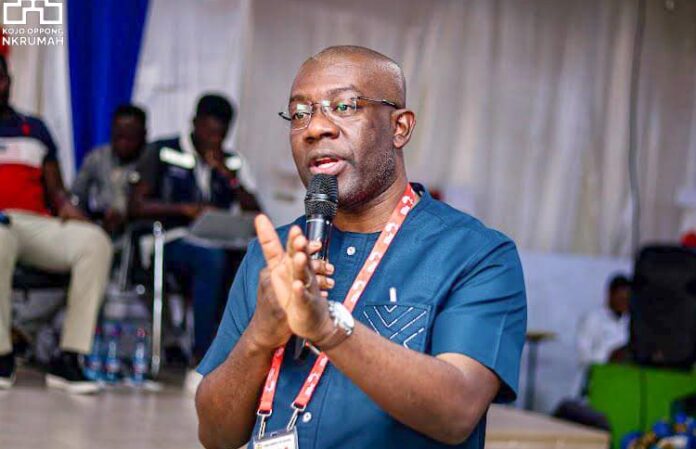

The Member of Parliament for Ofoase-Ayirebi Constituency, Kojo Oppong Nkrumah, has challenged claims by President John Dramani Mahama that the economy is improving, arguing that the government’s statistics do not reflect the real experiences of citizens across the country.
The former Information Minister said there is a wide gap between the government’s data-driven assessment of the economy and the everyday struggles faced by farmers, manufacturers, and service providers.
Contributing to the debate on the State of the Nation Address delivered by the President in Parliament, Mr. Oppong Nkrumah argued that government appears to be relying on figures generated in Accra rather than engaging with the realities confronting ordinary Ghanaians.
Also read: Nii Moi Thompson endorses renaming of Kotoka International Airport
According to him, visits by Minority Members of Parliament to farming communities and agro-processing centres revealed serious liquidity challenges that are affecting agricultural production and sales.
The Ofoase-Ayirebi legislator explained that rice farmers currently have thousands of bags stored in barns without buyers because there is little money circulating in the economy.
He added that maize farmers in northern Ghana face similar difficulties, with many unable to sell their harvest despite borrowing heavily to finance their farming activities.
He indicated that cashew farmers in the Bono and Ahafo regions are struggling with poor prices and limited market access, while cocoa farmers continue to face operational challenges that are affecting purchasing clerks and farm investments.
In some cases, he warned, cocoa farm owners are considering selling their farms to illegal miners because they believe it would generate better returns.
Mr. Oppong Nkrumah also raised concerns about the manufacturing sector, stating that Ghanaian manufacturers are currently worse off than they were in 2024. He cited rising production costs, including increases in electricity tariffs of about 28 percent, as well as escalating prices for locally produced raw materials needed for manufacturing.
Turning to the service sector, the MP said hairdressers, welders, cold store operators, and digital service providers are increasingly struggling to stay afloat due to rising utility costs and reduced consumer spending.
While acknowledging the government’s emphasis on falling inflation figures, he argued that the true measure of economic progress should be the cost of living and purchasing power of citizens rather than headline statistics.
Mr. Oppong Nkrumah also questioned government claims that one million jobs had been created within nine months, suggesting that the figure does not reflect the realities in constituencies across the country where youth unemployment remains a major concern.
He accused the government of avoiding parliamentary scrutiny on key financial issues, including motions filed by the Minority to investigate an alleged $214 million loss on gold transactions and the reported sale of a significant portion of Ghana’s gold reserves.
According to him, the current state of the nation is characterised more by policy rebranding than substantive economic transformation, citing the renaming of the Precious Minerals Marketing Company (PMMC) to the Ghana Gold Board and other government initiatives.
The debate is expected to continue in Parliament in the coming days as both Majority and Minority lawmakers present contrasting interpretations of the country’s economic and social conditions.