


The Ministry of Finance has revealed widespread irregularities in government arrears after an audit found GH¢8.1 billion in invalid claims, including fictitious debts, duplicated invoices and unsupported payment requests.
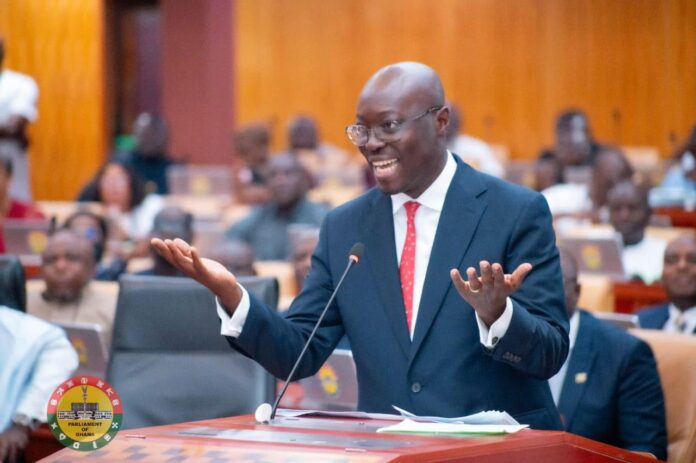
Presenting a statement to Parliament on behalf of Finance Minister Cassiel Ato Forson, Deputy Finance Minister Thomas Nyarko Ampem said the audit exposed what he described as “systemic plunder and abuse of the public financial management system.”
The statement, delivered on Tuesday, March 10, 2026, detailed the findings of the Ghana Audit Service on arrears and payables owed by government as of the end of 2024.
Also read: NHIS had GH¢1bn surplus when NPP exited, not debt – Ayew Afriyie counters Health Minister
“By the time I am done with this presentation, it will become clear that something needed to be done to save our economy,” he told Parliament.
According to the Finance Ministry, a total of GH¢68.7 billion in arrears submitted by ministries, departments and agencies (MDAs) was subjected to verification.
The audit, conducted by the Ghana Audit Service in partnership with Ernst & Young and PwC, examined unpaid interim payment certificates (IPCs), invoices and bank transfer advices submitted to the Ministry of Finance.
Out of the total amount audited: GH¢45.4 billion was validated for paymentG, GH¢8.1 billion was rejected due to irregularities, GH¢13.3 billion remains pending further verification.
“This GH¢1 billion that was rejected by the audit would have been paid if the Ministry of Finance had not made a bold decision to stop payments in January 2025,” the Deputy Minister explained.
One of the most shocking findings involved a GH¢89.4 million fictitious debt submitted under the One District One Factory (1D1F) programme.
The former Ministry of Trade and Industry had requested the amount as government contributions toward interest payments to five commercial banks.
However, when auditors contacted the banks, all denied being owed any money.
“Without the audit intervention, a whopping GH¢89.4 million of hard-earned public money could have been disbursed to settle this non-existent liability,” the statement said.
Auditors also discovered a supposed GH¢10.5 million payment to a ‘Buffer Account’ which turned out to be fictitious, as the account number did not exist within the bank’s records.
The audit further uncovered discrepancies in government purchases of food supplies meant to address the effects of a dry spell.
According to the report, government paid for 34,000 metric tonnes of rice, but the Ministry of Food and Agriculture confirmed receipt and distribution of only 24,000 metric tonnes, leaving 10,000 metric tonnes unaccounted for.
Similarly, a contractor engaged to supply 100,000 metric tonnes of maize worth GH¢771.2 million delivered only 11,900 metric tonnes, despite documentation claiming full delivery.
The report also revealed overpayments and unsupported financial transactions across several government institutions.
Under the Farmer Food Relief and Recovery Programme, a transport company contracted to move 134,000 metric tonnes of maize and rice was paid GH¢50 million, despite transporting only 35,000 metric tonnes.
The company also received 7,311 metric tonnes of rice worth GH¢11.7 million in lieu of cash.
Meanwhile, auditors identified GH¢293 million in bank transfer advices without supporting documentation, involving institutions such as: Ministry of Gender, Children and Social Protection, Ministry of Roads and Highways, Judicial Service, and the Ministry of Health.
Another troubling finding was the discovery of GH¢4.4 billion in recycled claims that had already been paid between 2020 and 2024 but were resubmitted for payment.
The duplicated claims involved several MDAs including the Ministry of Roads and Highways, Ministry of Health, Ministry of Energy, and Ministry of Food and Agriculture.
“But for our vigilance, the Ghanaian taxpayer would have lost a colossal GH¢4.4 billion in these recycled claims,” the statement noted.
The audit also raised concerns about the Agenda 111 health infrastructure initiative.
According to the findings, US$7.9 million paid as mobilisation funds to 35 contractors had either not resulted in work on site or the work done was not commensurate with the funds received.
Additionally, the advance mobilisation guarantees secured by the contractors had expired.
The Finance Ministry has referred the report to the Attorney-General’s Department for further action against individuals implicated in the irregularities.
“Those who abused their offices, colluded with contractors, falsified records or attempted to loot the public purse will be held to account,” the Deputy Minister said.
The government has also announced stricter financial controls going forward.
“No payment will be made without full verification, no commitment will be entered into without budgetary allocation, and no officer, regardless of rank, will be shielded from accountability,” the Deputy Minister stressed.
The Finance Ministry says the findings highlight deep weaknesses in Ghana’s public financial management architecture and underscore the need for urgent reforms.
He stressed that the government of John Dramani Mahama is committed to strengthening accountability and preventing further abuse of public funds.
“The Ghanaian people demand accountability, and under this government that demand will be met with action,” the statement added.