

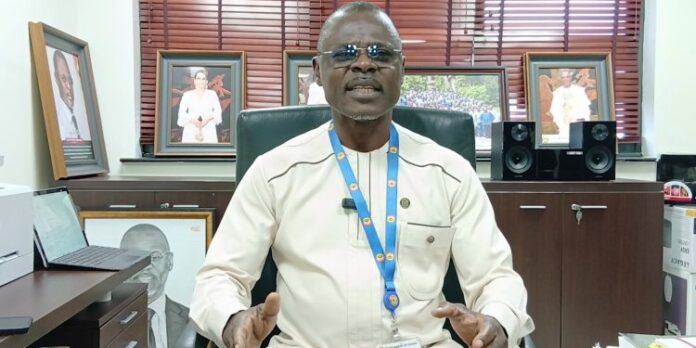

Member of Parliament for Garu, Thomas Winsum Anabah, has raised concerns in Parliament about Ghana’s growing shortage of medical doctors, warning that the crisis threatens equitable access to quality healthcare nationwide.
The legislator described the shortage of health professionals as a major national challenge that continues to undermine healthcare delivery.
“Across Ghana, many health centres and district hospitals remain critically understaffed. While infrastructure and equipment are vital, the absence of adequately skilled personnel continues to undermine access to quality healthcare,” he said.
Also read: GH¢4.2bn released to LBCs as COCOBOD moves to settle farmers’ debt
Delivering a statement in the House on Thursday, the Garu MP disclosed that Ghana’s physician-to-population ratio currently stands at about 2.66 doctors per 10,000 people — far below global standards.
He explained that the World Health Organization recommends a minimum of 10 doctors per 10,000 people, while the global average stands at approximately 17.2.
“This clearly shows how far we must go as a country in closing the physician gap,” Dr. Anabah told Parliament.
Data from the Ghana Medical and Dental Council indicates that Ghana currently has about 12,886 registered medical doctors.
With a population of roughly 32 million, the country would require about 32,000 doctors to meet the World Health Organization’s benchmark — leaving a deficit of nearly 19,000 physicians.
The Garu MP noted that although Ghana trains between 900 and 1,000 doctors annually, the country continues to lose a significant portion of them to migration.
“About 35 percent of locally trained doctors emigrate each year in search of better remuneration, working conditions, and professional opportunities,” he stated.
He warned that even if all newly trained doctors were retained, it would take nearly two decades for Ghana to close the physician gap.
Dr. Anabah also lamented the uneven distribution of doctors across the country, with rural districts facing the most severe shortages.
He said some urban health facilities enjoy relatively adequate staffing, while many rural areas operate with only one or two doctors serving tens of thousands of residents.
“In some districts, including Garu, only one or two doctors serve populations of over 40,000 people. This situation places lives at risk,” he stressed.
Dr. Anabah told Parliament that Ghana could draw lessons from other countries that have implemented reforms to address doctor shortages.
He cited examples from Canada, Australia, Israel, and Singapore, where governments have simplified licensing systems, introduced exam waivers, and expanded recognition of foreign medical qualifications.
“We should make it easier for Ghanaian doctors abroad to return and practice, and for qualified foreign-trained doctors to contribute without compromising patient safety,” he proposed.
He also pointed to “Practice Ready Assessment” programmes in Canada and Australia that allow experienced, foreign-trained doctors to complete supervised clinical practice before full licensure.
The Garu legislator outlined a multi-pronged strategy to address Ghana’s healthcare workforce deficit.
Key proposals include adopting competency-based medical education across training institutions, introducing flexible postgraduate training pathways, and reforming licensing systems to attract international medical graduates.
He also called for policies that align immigration frameworks with health workforce needs to help recruit doctors to underserved communities.
“We must design targeted recruitment strategies that prioritise deprived districts,” he said.
The MP stressed that Ghana’s goal of achieving universal health coverage by 2030 depends heavily on strengthening the country’s health workforce.
“No health system can function without an adequate number of motivated and well-trained doctors and nurses,” he said.
He urged Parliament to approach the issue with urgency to ensure all communities have access to quality healthcare.