

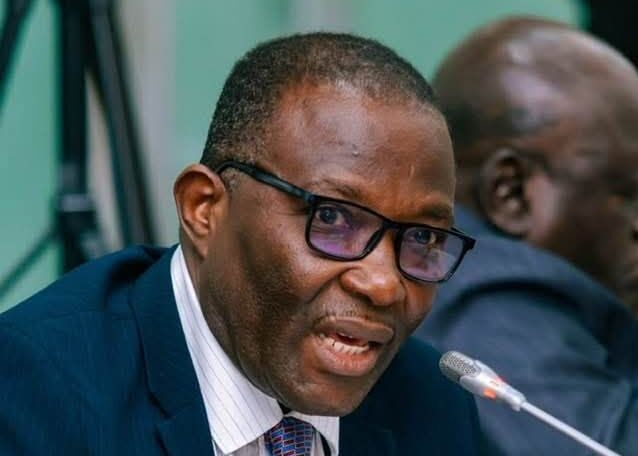

Member of Parliament for Kpando Constituency, Sebastian Deh, has appealed for a stronger national commitment to financial inclusion for smallholder farmers, stressing that access to tailored financial services is critical for improving agricultural productivity and rural livelihoods.
The lawmaker emphasized that smallholder farmers remain the backbone of Ghana’s agricultural sector, despite facing persistent economic challenges.
Delivering a statement in Parliament on Thursday, the MP pointed out that agriculture employs over half of Ghana’s population and contributes significantly to Ghana’s GDP, and yet smallholder farmers remain among the most economically vulnerable in our society.
Also read: The Front pages: Friday, 13th March, 2026 (Newspapers)
Tano South MP pushes national strategy to revive Cylinder Manufacturing firm
According to him, smallholder farmers constitute about 70 percent of the country’s farming population and produce the majority of staple foods, including maize, cassava, yams, and vegetables.
He noted that their contributions are critical to national food security, poverty reduction, and economic growth.
However, Deh observed that farmers continue to struggle with limited access to affordable credit, poor market linkages, inadequate extension services, climate change impacts, and significant post-harvest losses.
“Addressing these challenges holistically is necessary if we are to achieve food self-sufficiency and sustainable rural development as a country,” he told the House.
The Kpando legislator highlighted financial exclusion as one of the biggest barriers to agricultural growth, particularly in rural communities.
“Without access to affordable loans and financial services, farmers cannot invest in improved seeds, fertilizers, mechanization, and post-harvest infrastructure,” he explained.
Deh commended Opportunity International Savings and Loans for its role in bridging the financial inclusion gap through specialized agricultural finance programmes.
According to him, the institution has been operating in Ghana for more than two decades and provides innovative financial products tailored to smallholder farmers, agribusinesses and micro-entrepreneurs.
Its agricultural finance initiatives focus on value-chain financing, seasonal farm loans, financial literacy training, and digital banking solutions for rural farmers.
“This combination of credit, training, and market linkages has helped thousands of smallholder farmers improve productivity and incomes,” he noted.
To illustrate the impact of financial inclusion, the MP shared the story of Ama Mensah, a maize farmer in the Bono Region who accessed her first agricultural loan in 2020 through Opportunity International.
With the loan, she purchased improved seeds and fertilizers and hired mechanized services for ploughing, while also benefiting from financial management training.
“Her maize yield increased by 70 percent, enabling her to sell at competitive prices, expand her farm, and pay her children’s school fees,” Deh said.
He added that similar success stories have been recorded across farming communities in the Volta and Oti regions.
To scale up support for farmers nationwide, the Kpando MP proposed several policy interventions.
Key among them is the establishment of an Agricultural Finance Support Fund to de-risk lending to farmers and encourage banks to expand agricultural loan products.
He also called for scaling up the work of Ghana’s Incentive-Based Risk Sharing System for Agricultural Lending to further reduce financial risks associated with agricultural financing.
Other recommendations include strengthening public-private partnerships, expanding digital financial services through mobile money, and creating a national database of farmers to improve credit scoring systems.
Hon. Deh stressed that supporting smallholder farmers should be treated as a national development priority.
He added that empowering farmers through finance, training, and market access will strengthen rural economies and enhance food security under the vision of President John Dramani Mahama.