

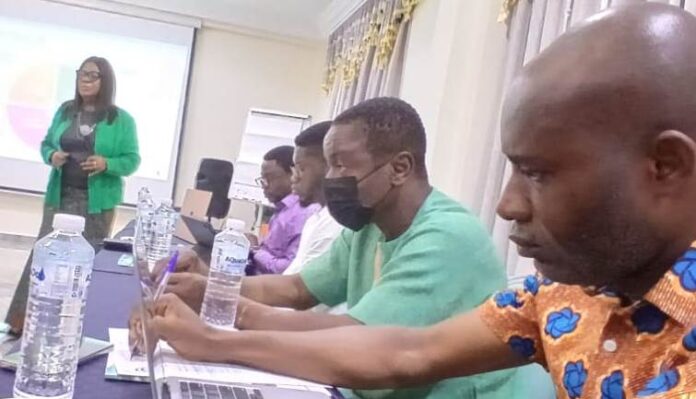

Parliament, in collaboration with the World Bank and the Foreign, Commonwealth & Development Office (FCDO) of the United Kingdom, has organised a two-day capacity-building workshop for members of the Parliamentary Press Corps (PPC) to strengthen public financial reporting.
The training programme going on in Koforidua this weekend is aimed at enhancing the capacity of journalists who cover parliamentary proceedings to report accurately on public financial management and national budget issues.
It seeks to equip parliamentary reporters with the technical knowledge required to interpret complex financial information and translate it into clear and accessible reports for the public.
The initiative is also expected to strengthen transparency and accountability in governance by ensuring that citizens are better informed about how public resources are allocated and managed.
Also read: Government announces public holidays for Eid-Ul-Fitr and Shaqq Day
The training programme includes a series of sessions focusing on key aspects of financial reporting.
Participants are being taken through Ghana’s public financial management framework, methods for analysing national budgets, and the role of auditing institutions in promoting accountability.
The workshop also addresses ethics and responsible reporting on financial matters, highlighting the importance of accuracy, fairness and balance in public finance journalism.
Parliamentary work and public information
Speaking at the opening of the workshop, the Director of Media Relations at Parliament, David Sebastian Damoah, emphasised the crucial role journalists play in bridging the gap between Parliament and the public.
According to him, parliamentary work only achieves its full impact when it is effectively communicated to citizens.
“The work of Parliament does not end within the walls of the chamber. It becomes meaningful to the public only when it is accurately communicated, clearly interpreted and responsibly reported to the citizens we serve,” he stated.
Mr. Damoah noted that Parliament is the institution where national budgets are debated and approved and where government expenditure is scrutinised.
However, he pointed out that financial oversight processes are often technical and complex, making it essential for journalists covering Parliament to develop a strong understanding of public financial management.
He commended development partners for supporting the initiative and encouraged participants to take full advantage of the training.
“A well-informed public is the foundation of a strong democracy. Through this training, we are taking an important step to ensure that citizens receive accurate, balanced and insightful information about public policy and financial governance,” he said.
Mr. Damoah expressed confidence that the knowledge gained from the programme would enhance the quality of parliamentary reporting and contribute to stronger transparency and accountability in public financial management.
Calls for stronger financial reporting
Dean of the PPC, Simon Agianab, in his welcome remarks urged members to deepen their understanding of economic policy and public financial reporting to improve the quality of parliamentary journalism in Ghana.
The Press Corps, he said, plays a crucial role in connecting the work of Parliament with the Ghanaian public.
“The Parliamentary Press Corps occupies a unique and critical position within our democratic architecture. As journalists assigned to cover the work of Parliament, we serve as a bridge between the nation’s law-making body and the citizens whose lives are shaped by decisions taken by the House,” he stated.
He stressed that parliamentary journalism goes beyond simply reporting proceedings in the chamber to interpreting complex legislative and policy discussions and presenting them in ways that are meaningful and accessible to the Ghanaian public,” he added.
Mr. Agianab further explained that the evolving economic and governance landscape has made parliamentary reporting increasingly demanding, particularly when dealing with complex financial and policy issues.
He stressed that economic policies, fiscal decisions and public financial management issues are often presented in technical language that can be difficult for the ordinary citizen to understand.
“It is therefore essential that members of the Parliamentary Press Corps are adequately equipped with the knowledge and tools necessary to interpret these issues accurately and communicate them effectively.”
The Dean expressed appreciation to the organizers for what he described as a timely initiative aimed at enhancing the professional capacity of journalists assigned to cover Parliament.