

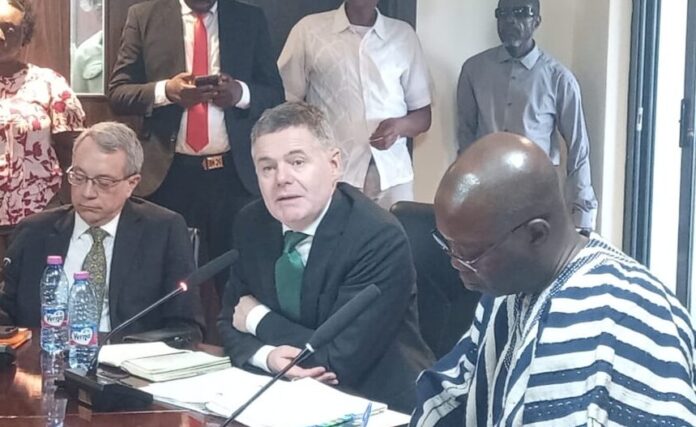

Managing Director and Chief Knowledge Officer of the World Bank Group, Paschal Donohoe, has reaffirmed the Bank’s commitment to strengthening its partnership with Ghana, announcing a multi-billion-dollar investment drive focused on jobs, skills, and economic growth.
Speaking during a meeting with the leadership of Parliament on Wednesday, Mr. Donohoe disclosed that the World Bank has committed an investment programme of over $3 billion across key sectors of Ghana’s economy.
The funding will target critical areas, including education, transport infrastructure, and energy sector development. The initiative also aims to support both government and private sector-led growth through financing and technical assistance.
Also read: Oil Prices surge past $110 after Iran gas field strike
A major priority for the World Bank, according to Mr. Donohoe, is job creation, particularly for Ghana’s growing youth population.
He said, “Our overall mission is… the creation of jobs within Ghana, ensuring young people have opportunities for economic development.”
He praised the entrepreneurial spirit of Ghanaian youth following visits to institutions such as the University of Ghana.
“I saw with my own eyes the potential, the energy, the entrepreneurial spirit that pulses through the people of Ghana,” he said.
He disclosed that the World Bank is also set to roll out new research and policy support aimed at boosting agriculture’s role in job creation, indicating that shortly a new report regarding growth and jobs in Ghana will be published.
The report will focus on irrigation systems, transport for agricultural produce, and skills training in agribusiness. The goal is to unlock the full potential of agriculture as a major employer in Ghana.
Mr. Donohoe also emphasized continued support for education at all levels, from basic to tertiary institutions, which aligns with broader efforts to equip Ghana’s workforce with relevant skills for a modern economy.
Mr. Donohoe reaffirmed the World Bank’s long-term commitment to Ghana’s development and the commitment to looking at how to maintain the relationship and strengthen it in the years ahead.
Majority Leader Mahama Ayariga, in his remarks, called for enhanced accountability and increased financial support from the World Bank to strengthen parliamentary oversight and economic governance in Ghana.
He expressed appreciation for the long-standing partnership between Ghana and the global financial institution.
He assured the delegation that Parliament is making effective use of the support provided under ongoing capacity-building programmes and reaffirmed Parliament’s commitment to strengthening governance systems through collaboration with development partners.
The Minority Leader, Alexander Afenyo-Markin, on the other hand, called for a bold national shift toward vocational and technical training to tackle Ghana’s growing youth unemployment crisis.
He stressed that job creation must become the central focus of economic policy and international partnerships.
He welcomed the World Bank’s focus on job creation and skills development, pledging bipartisan support for relevant policies.
“If such initiatives come to Parliament, we are all for it,” he assured.
He emphasized the need for long-term national development strategies beyond partisan politics, criticizing the growing politicization of key state institutions.
He stressed that collaboration between Parliament, government, and development partners remains crucial to building a resilient economy and securing Ghana’s future