


The Minority in Parliament has urged government to publish full details of all road contracts under the flagship ‘Big Push’ infrastructure programme.
According to the Caucus, transparency is essential to safeguarding public trust in the use of the estimated GH¢50 billion allocation.
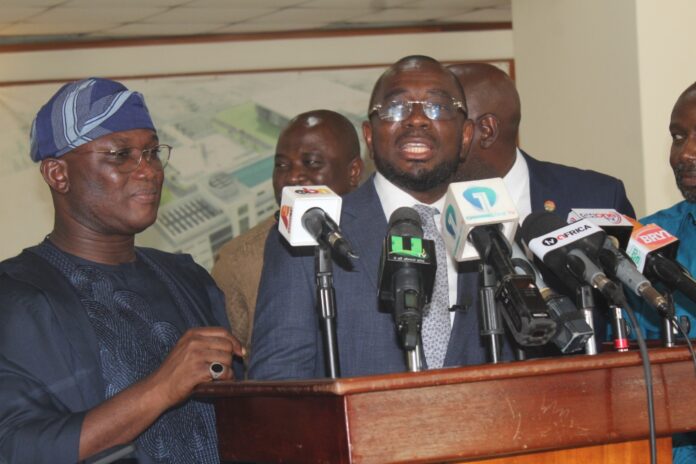
Addressing a press conference in Parliament on Tuesday, Ranking Member on the Roads and Transport Committee, Kennedy Nyarko Osei, stressed that while the Minority supports the policy in principle, concerns have emerged over the process used in awarding the initial 50 road projects.
The Minority maintains that full disclosure is necessary to allow Ghanaians to independently assess the value and fairness of the contracts.
Also read: Weaponising procurement: The relentless campaign to undermine Mahama’s ‘Big Push’ at all cost
Kennedy Nyarko Osei clarified that the Minority is not against the Big Push programme itself, but is concerned about procurement openness.
“The Big Push programme is in principle a commendable initiative. If adequately resourced and efficiently implemented, it has the potential to significantly improve connectivity and open up key economic corridors,” he stated.
“We on the Minority side are not opposed to the policy itself. Our concern, however, lies with the process through which the initial 50 projects have been awarded,” he added.
The Ranking Member emphasized that government must urgently publish key details of all awarded contracts, including the names of contractors, the scope of works assigned under each contract, and the unit cost per kilometre for the various projects.
According to him, this level of disclosure will help eliminate suspicion and promote accountability.
Citing figures presented in the 2026 State of the Nation Address, the Ranking Member noted that the programme is expected to cost taxpayers approximately GH¢50 billion.
Kennedy Nyarko Osei argued that such a significant public investment demands stronger transparency safeguards, especially given past political criticisms of procurement practices.
“These are issues the current government spoke vehemently against while in opposition. There is therefore a legitimate expectation that, once in government, higher standards of transparency would be upheld,” he noted.
He outlined estimated industry benchmarks for road construction costs, which he said should guide public evaluation of the contracts once details are released, noting that bitumen surface roads typically range between USD 400,000 and USD 650,000 per kilometre, surface dressing roads between USD 600,000 and USD 800,000 per kilometre, single carriageway asphaltic overlays between USD 1.2 million and USD 1.8 million per kilometre, and dual carriageway overlays between USD 2.5 million and USD 4 million per kilometre.
These benchmarks, he said, should help Ghanaians determine whether project pricing under the Big Push programme is within acceptable limits.
He argued that transparency should not end at contract award.
“Even after the award of these contracts, they should be advertised. Ghanaians have the right to know how these funds are being allocated given the scale and significance of the programme,” he said.
The Minority therefore challenged the government to immediately publish all relevant details of the 50 Big Push road contracts as part of efforts to strengthen accountability and public confidence in infrastructure delivery.