

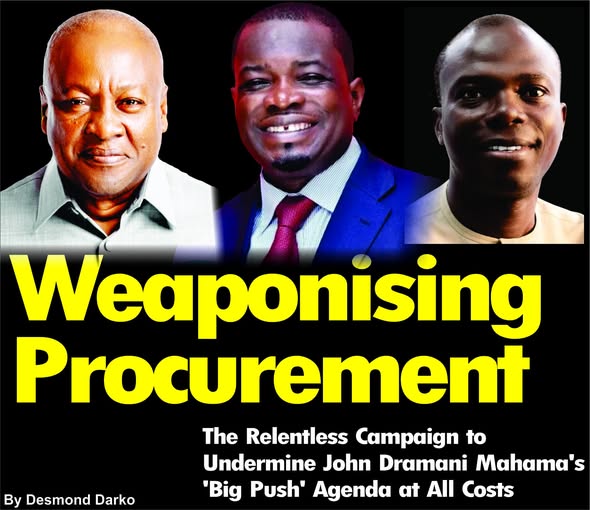

The attempt to spin recent procurement developments into a grand narrative of failure is not only exaggerated. It reflects an overzealous, almost desperate effort to manufacture scandal under the guise of public interest advocacy.
At the centre of the criticism is President John Dramani Mahama and his administration’s flagship ‘Big Push’ infrastructure programme. Critics point to the use of sole-sourcing in the award of road contracts as evidence of a betrayal of campaign promises. However, such a conclusion, while convenient, ignores both context and intent.
First, let us be clear. Sole-sourcing is not illegal. Ghana’s procurement framework explicitly provides for it under defined circumstances. To suggest that its use automatically constitutes wrongdoing is to mislead the public and undermine the very legal structures governing public procurement. Indeed, Section 40 of the Public Procurement Law permits single-source procurement on grounds of urgency, subject to approval by the Public Procurement Authority (PPA).
Also read: Bawumia tasks Minority MPs to engage stakeholders nationwide
More importantly, the Big Push is not a routine government programme. It is an accelerated national intervention designed to tackle Ghana’s deep infrastructure deficit. The deplorable state of roads across the country is not merely an inconvenience. It is a national concern with serious implications for safety, economic activity, and even security. Poor road conditions have contributed to fatal accidents and, in some cases, heightened vulnerability to crime.
In such a context, speed and capacity matter. The argument advanced by the Ministry- that contractors must possess the technical expertise, equipment, and financial strength to deliver within tight timelines- is not only reasonable but necessary. Competitive tendering, while ideal in principle, is often slow and bureaucratic in practice.
Available information indicates that the surveying, design, and costing of Big Push projects alone took approximately seven months. Subjecting these projects to full national competitive tendering would likely have added several more months before work could even commence, potentially pushing completion timelines well beyond 2028. There are precedents. Complex competitive tendering processes, such as that for the Road Toll project, have taken close to a year without conclusion.
When urgency is paramount, governments around the world adopt alternative procurement methods to fast-track critical projects. This is not an aberration. It is a pragmatic response to pressing national needs.
Yet, what we are witnessing is a deliberate refusal by some commentators to engage with this reality. Instead, they selectively interpret data to fit a predetermined narrative that the Mahama administration is acting in bad faith.
But beyond the numbers and procurement methods lies a more fundamental question- delivery.
Are roads being built? Are projects moving at a pace that reflects the urgency of the national need? By all observable indications, the answer is yes. Under John Dramani Mahama, road construction has taken on a new intensity, with projects advancing at a speed and scale that many Ghanaians have long demanded. This is the dimension that critics conveniently sidestep.
Public procurement is not an end in itself. It is a means to an end. That end is quality infrastructure delivered efficiently and within a reasonable timeframe. A procurement process that is procedurally perfect but results in stalled or abandoned projects serves little national interest. Conversely, a process that accelerates delivery, while remaining within the bounds of the law, must be assessed on the strength of its outcomes.
It is therefore not enough to ask how contracts are awarded. The more important question is: what is being delivered?
For years, complaints about road infrastructure centred not only on quality, but also on delays, cost overruns, and projects that dragged on endlessly. The current approach, whatever its imperfections, appears designed to break that cycle. The urgency embedded in the Big Push is being matched by execution. And that is a reality that cannot be ignored.
Even The Fourth Estate’s own findings, while raising legitimate questions about procurement methods, do not establish any illegality, abuse of process, or inflation of contract values. There is no scintilla of evidence presented to show that the use of sole-sourcing in these instances was unjustified or in breach of the law.
On the contrary, indications are that all sole-sourced contracts under the Big Push received prior approval from the PPA on grounds of urgency. Value-for-money assessments were undertaken, and contracts were distributed among multiple competent and experienced contractors, not concentrated in the hands of a select few. Payments, as is standard in road construction, are tied to certified work completed and verified by independent consultants.
It is also important to clarify a key distortion in the narrative. A significant number of the projects cited- such as the Suame Interchange, Ofankor–Nsawam, and Adenta–Dodowa roads, were not newly awarded by this administration. They were inherited projects initiated under the previous government, many of which were themselves sole-sourced and lacked dedicated funding. The current administration has merely novated these contracts, retained the contractors, and provided the necessary funding under the Big Push framework. Counting such projects as fresh sole-sourced awards is, at best, misleading.
This is where the conversation must mature. Accountability is essential, but it must not become blind to outcomes. Governance is not judged solely by adherence to process, but by the tangible improvements it delivers in people’s lives. Roads completed on time, connecting communities and boosting economic activity, are not theoretical gains. They are measurable progress.
The implication that this represents a wholesale abandonment of principle is therefore overstated. The National Democratic Congress never argued that sole-sourcing was unlawful. Its consistent position has been against its unjustified use and abuse. That distinction matters, and it remains relevant.
What we may be witnessing instead is a government prioritising results in the face of urgent national demands.
That does not mean there should be no scrutiny. The Mahama administration must continue to strengthen transparency, justify its procurement choices, and ensure value for money. However, it also deserves a fair assessment- one that recognises delivery, not just procedure.
Ghana’s democracy is best served not by one-sided narratives but by balanced evaluation. If the Big Push is delivering roads at unprecedented speed and scale, then that achievement must form part of the national conversation. Anything less is not accountability- it is selectivity.
Source: Desmond Darko, Editor-in-Chief, The Catalyst Newspaper