

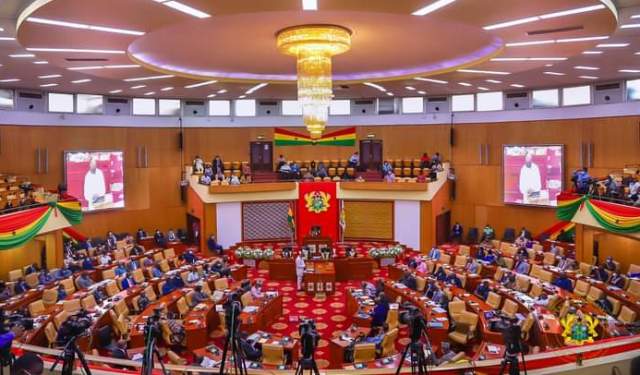

Parliament has rejected a private member’s motion seeking the establishment of an ad hoc committee to investigate the Gold-for-Reserves Scheme, following a tense and highly charged debate on the floor of the House.
The motion, moved by Minority Leader Alexander Kwamena Afenyo-Markin on Friday, March 27, 2026, and seconded by the Member of Parliament for Atiwa East, Abena Osei Asare, was defeated after a voice vote, with the Majority Caucus voting against it.
Following the rejection, Mr. Afenyo-Markin called for a secret ballot. However, the Speaker of Parliament, Alban Kingsford Sumana Bagbin, declined the request.
The Speaker explained that secret voting procedures are limited to constitutional matters, such as amendments and the election or removal of persons holding public office under the Constitution or any other law.
Also read: Parliament adjourns sine die as Majority, Minority leaders urge unity and discipline
Moving the motion, Mr. Afenyo-Markin argued that Parliament had a constitutional duty to investigate reported losses of $214 million incurred by the Bank of Ghana under the scheme, as highlighted by the International Monetary Fund.
Supporting the motion, Mrs. Osei Asare stressed the magnitude of the losses, noting that the figure exceeded the GHS 1.8 billion recorded under the Gold-for-Oil programme and represented about 2% of Ghana’s Gross Domestic Product (GDP).
She further argued that the amount was nearly 29 times the allocation approved for the government’s 24-hour economy policy, insisting that such funds could have been channelled into critical national development projects.
Raising governance concerns, she warned that questions around traceability, due diligence, and the possible inclusion of illegally sourced gold in a state-backed programme could point to deeper systemic challenges.
However, the Member of Parliament for Amenfi West, Eric Afful, attributed the programme’s challenges to its initial implementation under the previous New Patriotic Party (NPP) administration in 2022.
He cited central bank data indicating losses of GH¢74 million in 2022, GH¢2.15 billion in 2023, and GH¢4.84 billion in 2024.
Mr. Afful, however, defended the programme’s recent performance, claiming that between March and September under the current administration, the country accumulated $10.8 billion in reserves through the initiative, delivering significant economic gains.
The Majority Leader and MP for Bawku, Mahama Ayariga, dismissed the Minority’s claims as flawed.
He maintained that the Gold-for-Reserves programme was not designed as a profit-making venture but rather as a strategic policy tool to leverage Ghana’s gold resources to strengthen foreign reserves and stabilise the economy.
The rejected motion sought to establish a committee to investigate the scheme across five key areas, including compliance with the Gold Board Act, 2025 (Act 1140), supply chain processes, transparency and accountability mechanisms, environmental and social impacts, and other related matters.
The Minority also referenced emerging reports suggesting that total losses under the programme could have risen to as high as $700 million, reinforcing calls for parliamentary scrutiny.
Proceedings were marked by frequent interruptions from both sides of the House, underscoring deep divisions over the policy’s effectiveness, governance, and economic justification.
Despite the Minority’s push for accountability, the rejection of the motion means no parliamentary probe will be constituted at this time.