

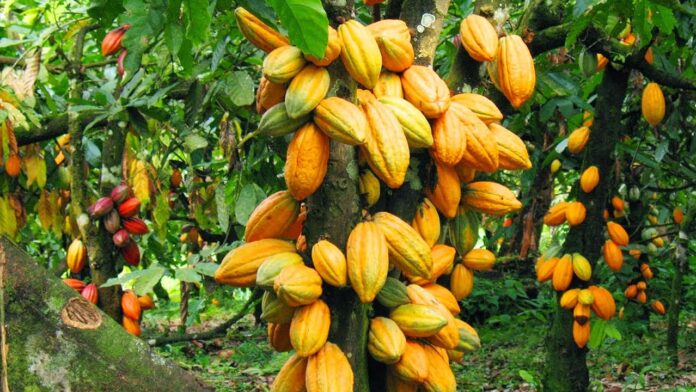

Cocoa prices tumbled sharply on Tuesday, settling at $3,138 per tonne, with New York cocoa hitting a one-month low and London cocoa slipping to a 1.5-week low, as improving supply conditions and weak global demand weighed heavily on the market.
Fresh data from the Ivory Coast showed increased cocoa arrivals, adding downward pressure on prices. Farmers shipped 1.45 million metric tonnes (MMT) of cocoa to ports between October 1, 2025, and April 4, 2026—up 0.7% from 1.44 MMT recorded during the same period last year.
Demand-side concerns are also intensifying. According to Bloomberg Intelligence, early projections indicate global chocolate sales during the Easter season could decline by about 5% year-on-year, reflecting consumer resistance to high chocolate prices.
Also read: Gold rallies over 3% after US–Iran ceasefire, oil prices tumble
Meanwhile, cocoa inventories monitored by ICE climbed to a 19-month high of 2,417,397 bags on Monday, signalling ample supply in the market.
Despite last week’s brief rally—driven by inadequate rainfall and drought concerns in West Africa—prices have come under renewed pressure. Data from the African Flood and Drought Monitor shows that drought conditions continue to affect more than half of the Ivory Coast and about two-thirds of Ghana, two nations that together produce over half of the world’s cocoa.
Market positioning is also playing a role. Funds have built significant short positions in London cocoa, with net shorts rising to 33,827 contracts in the week ended March 31—the highest level in over eight years. Analysts say this could trigger a short-covering rally if market sentiment shifts.
Geopolitical developments are adding complexity. Disruptions linked to the Strait of Hormuz have increased shipping, fuel, and fertilizer costs, potentially raising expenses for cocoa importers.
Policy decisions in key producing countries are further shaping the outlook. Ghana recently reduced the official price paid to cocoa farmers by nearly 30% for the 2025/26 season, while the Ivory Coast announced a 57% cut for its mid-crop harvest.
Weak demand indicators remain a major drag on prices. Barry Callebaut AG, the world’s largest bulk chocolate producer, reported a 22% drop in cocoa division sales volume for the quarter ending November 30, citing subdued market demand.
Grinding data also paints a bearish picture. The European Cocoa Association reported an 8.3% year-on-year decline in Q4 grindings to 304,470 metric tonnes—the lowest level for a fourth quarter in 12 years. Similar trends were observed in Asia and North America, where growth remained weak or negative.
Additional pressure is coming from Nigeria, the world’s fifth-largest cocoa producer, where exports rose 17% year-on-year in December to 54,799 metric tonnes. However, production in Nigeria is expected to fall by 11% in the 2025/26 season.
On the supply outlook, the International Cocoa Organization recently raised its global cocoa surplus estimate for 2024/25 to 75,000 metric tonnes, marking the first surplus in four years. Global production is projected to increase by 8.4% year-on-year to 4.7 MMT.
Looking ahead, analysts expect continued surpluses. StoneX forecasts a global cocoa surplus of 287,000 metric tonnes in 2025/26 and 267,000 metric tonnes in 2026/27, suggesting sustained pressure on prices unless demand rebounds.
Barchart