

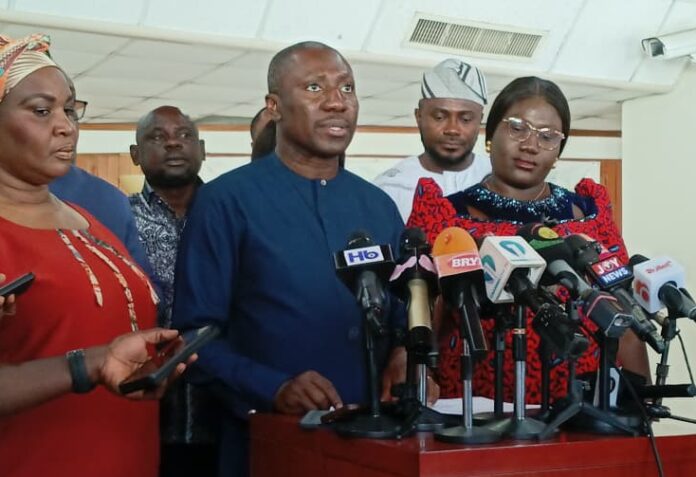

The Minority in Parliament has accused the government of attempting to secretly reintroduce the controversial Electronic Transfer Levy (E-Levy) through what it describes as an unconstitutional 0.75% charge on wallet-to-bank transactions.
Minority Leader Alexander Kwamena Afenyo-Markin claimed the new charge breaches Article 174 of Ghana’s 1992 Constitution, insisting that the government cannot impose transaction-based levies without parliamentary approval.
The controversy follows reports that the Bank of Ghana directed Mobile Money Fintech Ltd to suspend the implementation of the 0.75% charge, which had been scheduled to take effect from June 1, 2026, pending further consultations.
Also read: Parliament passes anti-LGBTQ+ Bill as Ayariga and Afenyo-Markin clash
Reacting to the development, Afenyo-Markin questioned the Central Bank’s role in the matter, arguing that the suspension order raises serious concerns about government involvement.
“If the government were truly uninvolved, on what authority did the Central Bank order a private operator to suspend the charge?” he asked.
According to the Minority Leader, the proposed transaction fee is economically identical to the E-Levy that Parliament repealed in March 2025 and which President John Dramani Mahama assented to in April 2025.
“A charge on financial transactions that is economically indistinguishable from a levy cannot be made lawful simply by routing it through a private fintech firm instead of the Consolidated Fund,” he argued.
Afenyo-Markin further warned that the proposed charge could negatively impact businesses and trade activities, particularly within the ports and logistics sector.
Citing concerns raised by the Ghana Freight Forwarders Association, he noted that wallet-to-bank transfers are widely used for customs duties, port charges, and supplier payments.
“They warn it will raise the cost of doing business and erode competitiveness at our ports. These are industry voices, not political ones,” he stated.
The Minority Leader also recalled President Mahama’s earlier criticism of the E-Levy while in opposition, when he described the tax in 2022 as “distortionary, burdensome, and a regressive tax.”
He further referenced comments by Deputy Finance Minister Thomas Nyaku Ampim, who previously argued that abolishing the E-Levy would return about GH₵2 billion to Ghanaians.
“If the government wants to reimpose transaction charges, it must come to Parliament. Lay a bill, make the case, and face a vote.”
“Anything less is an abuse of regulatory power to win through the back door what it cannot win through the front,” Afenyo-Markin stressed.