

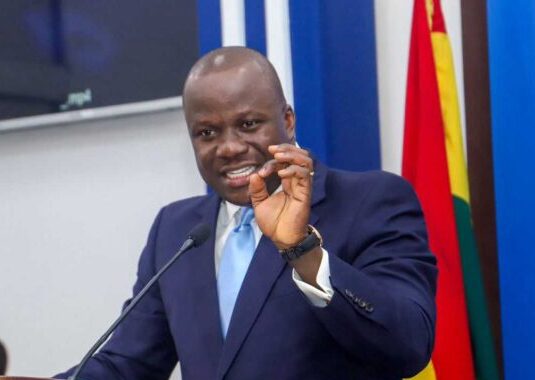

Member of Parliament for Damongo, Samuel Abu Jinapor, has urged Ghana to move beyond electronic visa reforms and pursue full visa-free travel across Africa as part of efforts to accelerate continental integration and economic cooperation.
In an article titled “E-Visa, Visa-Free Travel and the Future of African Integration,” the Ranking Member on Parliament’s Foreign Affairs Committee welcomed the government’s launch of the E-Visa platform but stressed that the reform should be viewed as a stepping stone rather than the final destination.
The E-Visa system, launched by the government on Africa Day, May 25, 2026, is designed to modernize visa administration, improve border management, and simplify travel into Ghana. Under the new arrangement, holders of African passports can apply electronically and are exempt from visa fees.
Also read: The Front pages: Monday, 1st June, 2026 (Newspapers)
While commending the initiative, Jinapor argued that the public must clearly understand the distinction between an electronic visa system and true visa-free travel.
“An electronic visa is principally an administrative innovation. Visa-free travel operates on an altogether different basis because eligible travellers require no prior authorization before departure,” he explained.
According to him, African passport holders travelling to Ghana under the new E-Visa arrangement still require prior approval before entry, meaning the system does not amount to visa-free travel.
The former Lands and Natural Resources Minister also highlighted what he described as the often-overlooked history behind Ghana’s E-Visa initiative, noting that the project was conceived and developed during the administration of former President Nana Addo Dankwa Akufo-Addo.
He recalled that in 2020, the Akufo-Addo government entered into a technical support agreement with Swiss security printing firm Orell Füssli Security Printing Limited and TGN Digital Security Limited to facilitate the deployment of machine-readable visa technology and electronic visa infrastructure.
Jinapor noted that subsequent policy development, stakeholder consultations, and technical preparations continued over several years, involving institutions including the Ghana Immigration Service, National Security, the Ghana Tourism Authority, and the Ministry of Finance.
“The E-Visa reform is a national achievement, and the history of how it came to be ought to be told in full,” he stated.
The Damongo legislator further argued that the broader objective should be the realization of Africa’s long-standing integration agenda, including the free movement of people, goods, services, and capital across the continent.
He referenced the African Union Protocol on Free Movement of Persons and the African Continental Free Trade Area (AfCFTA) as key frameworks designed to remove barriers to mobility and strengthen intra-African trade.
Drawing lessons from Europe’s Schengen Area, Jinapor observed that free movement can be achieved while maintaining strong border security through coordinated immigration systems, intelligence-sharing, and common regulatory frameworks.
He urged the government to accelerate the ratification and implementation of critical African Union and AfCFTA protocols, including the AU Protocol on Free Movement of Persons, the AfCFTA Digital Trade Protocol, and protocols relating to investment, competition policy, intellectual property rights, women, and youth in trade.
According to him, Ghana is uniquely positioned to lead the conversation on African integration due to its historical role in promoting Pan-Africanism and its status as host of the AfCFTA Secretariat.
“As Ghana approaches its Platinum Jubilee and President John Dramani Mahama prepares to assume the Chairmanship of the African Union, there is an opportunity for the country to reinforce its Pan-African credentials and provide renewed leadership on continental integration,” he said.
Jinapor also highlighted the importance of financial connectivity, noting that mobile money transactions across Africa reached an estimated US$1.4 trillion in 2025 despite the absence of a seamless continental payment system.
He argued that improved interoperability across payment platforms would significantly boost intra-African commerce, particularly for small businesses, women entrepreneurs, and young innovators.
The launch of the E-Visa platform, he said, deserves recognition, but he cautioned against losing sight of the broader vision of a continent where Africans can move, trade, and collaborate freely without unnecessary barriers.
“The future of African integration will ultimately be determined not only by the treaties that are signed or the institutions that are created, but by the practical choices individual countries make regarding openness, mobility, and cooperation,” he stated.